Farms.com Home   News

Soil Compaction Threat is High During Damp Fall Conditions

By Sjoerd Willem Duiker

Soil compaction continues to be a threat this fall because of high soil moisture content. Field work is in high gear with corn silage being wrapped up, manure being spread, and corn and soybean harvest underway. Several years ago, we did a study in continuous no-till where the entire soil surface was compacted in spring during damp conditions with one pass of a loaded, 30-ton manure truck mounted with road tires inflated to 90-100 psi. Corn yield reductions were 27% in a dry year, and 14% and 10%, respectively, in years with more favorable moisture conditions (see Figure 1).
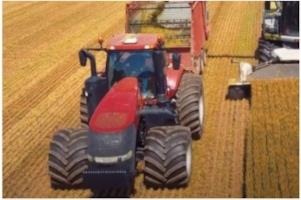
LSW tires on tractor are one way to increase the footprint

LSW tires on tractor are one way to increase the footprint and run low tire pressure while still carrying the load. This tractor was showcased at Penn State’s recent Field Crop Clinic in Landisville. Image Credit: Andy Jackson, Skyblu Farms

This shows that root growth reduction due to compaction makes the crop more susceptible to drought because it explores a smaller volume of soil for moisture. By using wide tires inflated to 35psi the damage was reduced by half. Today, there are tires that can be run at lower pressures while still being able to carry the load. Lower tire pressure results in less surface compaction. Farmers should check with their equipment dealers to determine what is the appropriate tire pressure to run in their tractor, combine, grain cart, and manure spreader tires. Lower pressure = less compaction.
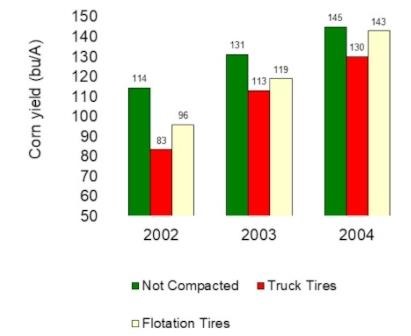
Corn yield in continuous no-till as affected by soil

Figure 1.  Corn yield in continuous no-till as affected by soil compaction with a 30-ton manure truck mounted with either road tires inflated to 100 psi or wide tires inflated to 35 psi.

Source : psu.edu

Trending Video

Western Canadian Agriculture: Hard Times Made the World's Best Farmers

Video: Western Canadian Agriculture: Hard Times Made the World's Best Farmers

Western Canadian agriculture produced the most advanced farmers in the world not through abundance but through adversity. The crow rate fell. The wheat price went nowhere. The brown envelopes stopped.

When the subsidies disappeared, the bad farmers left and the good ones stayed. And the ones who stayed could not just grow wheat anymore. They started growing lentils and canola and peas and flax and faba beans. They built crop rotation. They got serious about agronomy because there was no government backstop. That process produced the Western Canadian agriculture Dennis Bulani describes in this clip: the most advanced, most educated farming culture in the world.

His contrast with Iowa corn and soybean farmers is sharp. At a DeKalb farmer meeting in Okoboji, Iowa, he asked what crop rotation they ran. Beans on corn stubble, corn on bean stubble. How do you fertilize? The co-op agronomist handles it. Have you considered other crops? No need. We make so much money on corn and soybeans. Western Canadian agriculture was never allowed that comfort. And now those Iowa farmers are watching soybean markets lock up with China and corn prices slide, and they do not have the agronomy knowledge or the research base to pivot. Western Canadian farmers adapted on a dime because they had done it before.

Dennis also makes the case that Western Canadian agriculture keeps adapting in real time. Low commodity prices over the past year have pushed growers to look seriously at precision spot-spray technology. He knows a neighbor who bought a sprayer with the seeing-eye system and sprayed only 80 out of 320 acres. As a chemical retailer Dennis acknowledges that will affect his sales. He supports it anyway, because if it advances Canadian agriculture and makes farmers money, that is a good outcome.

The lesson Dennis draws from the tale of two farms: continuous improvement is the only durable strategy. When canola was $22 a bushel some growers went to Arizona instead of the Crop Production Show. When the price came down those same growers came back to the research and the discipline. Products do not go on Rack Petroleum's shelves unless they pass a replicated trial first. That is what Western Canadian agriculture built through hard times: farmers who do the work whether the times demand it or not.

Dennis Bulani is CEO of Rack Petroleum and Ultimate Yield in Biggar, Saskatchewan. Dan Aberhart hosts GTF Productions, Western Canadian Agriculture's foremost live briefing platform and its foremost AI training platform for ag operators