By SJOERD WILLEM DUIKER
Soil conservation continues to be one of the top priorities for sustainable soil use.
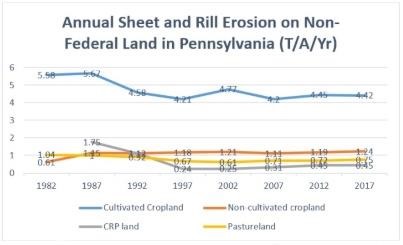
Every 5 years USDA publishes the National Resources Inventory. It provides updated information on the status, condition, and trends of land, soil, water, and related resources on the Nation’s non-Federal lands. The last NRI report was for the year 2017. Soil erosion by sheet and rill erosion is one of the parameters published. It is estimated using data obtained from the USDA-NRCS Revised Universal Soil Loss Equation calculations. The last report showed that, from 1982 to 2017, soil erosion on cultivated cropland decreased from 5.58 to 4.42 T/A/yr in Pennsylvania (see Figure). Cultivated land comprises land in row crops or close-grown crops, as well as other cultivated cropland; for example, hayland or pastureland that is in a rotation with row or close-grown crops. The erosion rate on non-cultivated cropland was much lower although it increased a bit from 1.04 T/A/yr in 1982 to 1.24 T/A/yr in 2017. Non-cultivated cropland includes permanent hayland and horticultural cropland. The increase is probably due to increasing horticultural cropland acreage in Pennsylvania. Soil erosion on CRP land, much of which is HEL (Highly Erodible Land) was 1.75 T/A/yr in 1987 but decreased to levels less than 0.5 T/A/yr in 2017. The higher levels of soil loss in 1987 and 1992 were probably because the CRP program started in 1985 and the vegetation was still in early phase of establishment. On permanent pastureland, soil erosion varied from 0.75-1.04 T/A/yr. It is useful to compare these numbers with the ‘tolerable soil loss level’ (T), which is published for each soil series. If the actual soil loss is less than T, land use is supposed to be sustainable. T varies from 1 T/A/yr for shallow soils to 5 T/A/yr for the most productive, deep soils. Therefore, soil loss levels less than 1 T/A/yr are considered very sustainable, but levels higher than that may exceed the tolerable level, depending on the soil type. It should be noted that many soils in Pennsylvania have a ‘T’ that is less than 5 T/A/yr. Therefore, although significant progress has been made over the last 40 year, we can conclude that, since average soil erosion on cultivated cropland is still 4.42 T/A/yr soil erosion still continues to be a major concern with many farm fields still losing soil at unsustainable rates. We also see that pasture or permanent grassland is a very sustainable form of land use in our state where many fields have steep slopes. With the expected increase in total quantity of precipitation in Pennsylvania in the future, and increasing intensity of rainstorms, soil erosion continues to be a menace to farmland productivity and environmental quality.
Source : psu.edu