By Elaine Kub
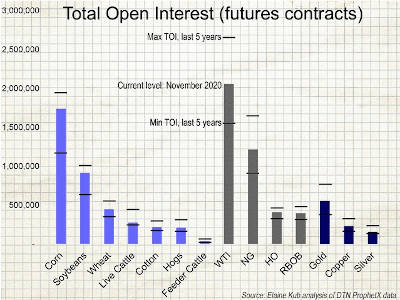
I've been thinking a lot about soybeans lately, and I'm not the only one. Participation in the soybean futures market surged to an all-time high of 1,049,850 contracts (total open interest) on Oct. 21. Traders have taken some profits and pared their positions since then, but total open interest in the soybean market remains at the 95th percentile of anything seen in the past five years.
Not coincidentally, soybean prices are just about the highest they've been in the past five years. High prices seem to attract attention, which seems to boost prices further, and so forth. At $11.75, the continuous front-month soybean chart isn't remarkable from a historical perspective -- not compared to the all-time high of $17.94 3/4 from September 2012 or even the more recent highs of $12.08 1/2 from June 2016 or $15.36 3/4 from May 2014 -- but it's a 45% improvement on the $8.08 low from this April. That's the kind of rally that grabs headlines and attracts speculative investors' money.
Perhaps these investors just don't have anything better to do with their money? Huge pockets of wealth have been created while the U.S. Federal Reserve has loosened monetary policy, and low interest rates have allowed asset prices to shift higher. If an investor put $1,000 into the stock market on Jan. 1, 2019, by today that account would be worth $1,436, give or take some dividends and fees (using the S&P 500 Index as a proxy). What should the investor do with the new $436? Some stock market investors have liabilities they need to pay out (e.g. pensions), but a large portion of stock market investors are already wealthy enough not to need their investment gains for groceries or school supplies, so instead they just pour the gains into more investments. They buy more stocks, maybe, at relatively high prices or they diversify into other asset classes, such as bonds, real estate or, yes, commodities. There are only so many things an investor can even buy.
I wondered if the entire commodity asset class has been affected by a noticeable inflow of investor funds -- was total open interest up for everything, not just soybeans? It turns out, no. Wheat, at around $6 per bushel for the Chicago SRW contract, has a total open interest that's only at the 48th percentile of the participation levels we've seen through the past five years. Corn, like soybeans, is priced about as high as we've seen in recent years, but total open interest in its futures market was much higher last summer and the summer before that. The abandoned lean hog market has lost its attractiveness since the African swine fever headline-grabbing days of last summer and now has total open interest at only the 15th percentile of the past five years.
Moving away from just the agricultural commodities, the granddaddy WTI crude oil futures market is huge -- 2,056,726 contracts of total open interest at last count, but that's a far cry from the record-high 2,662,724 contracts back in May of 2018. Gold, which you'd think would be pretty popular in times of geopolitical instability, is sitting at a relatively high price, $1,887 per ounce, but total open interest in gold futures is at only the 70th percentile of what's been seen in the past five years.
Click here to see more...