U.S. risks losing $5.4 billion in dairy export business without swift action to deliver a strong trade agreement with one of the world’s largest dairy buyers.
Japan is the largest cheese importer in the world and a significant buyer of whey, lactose and other dairy products. Forecasts suggest Japanese dairy imports will continue to grow in the years ahead due to rising consumption and constraints on the nation’s domestic dairy farming sector.
However, the United States’ ability to win a larger share of that export demand or even maintain its current level of dairy business with Japan is in jeopardy due to recent Japanese trade agreements with U.S. Dairy export competitors. Through preferential market access provisions in the EU-Japan Economic Partnership Agreement and the Comprehensive and Progressive Agreement for Trans-Pacific Partnership (CPTPP), the European Union, New Zealand and Australia have gained a significant market access advantage.
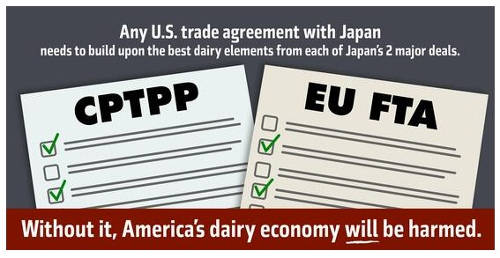
Without a strong U.S.-Japan free trade agreement, USDEC estimates competitors could win half of existing U.S. export business in Japan, with lost sales mounting to a total of $5.4 billion when the EU-Japan deal and CPTPP are fully phased in.
“There is no question that the U.S. dairy industry can compete in the Japanese market,” says John Wilson, senior vice president and chief fluid marketing officer at Dairy Farmers of America (DFA). But “to maximize opportunities there, we need a trade deal that at least puts us on a level playing field with competitors like Australia, New Zealand and the EU. We’re hopeful that a strong U.S.-Japan free trade agreement can be negotiated soon and think it’s critical for the continued growth and success of the U.S. dairy economy.”
Click here to see more...