The marketing year ended Aug. 31, for which numbers became available this week, recording the fifth highest overall export total for U.S. ethanol exports, 1.31 billion gallons, despite market challenges due to COVID-19.
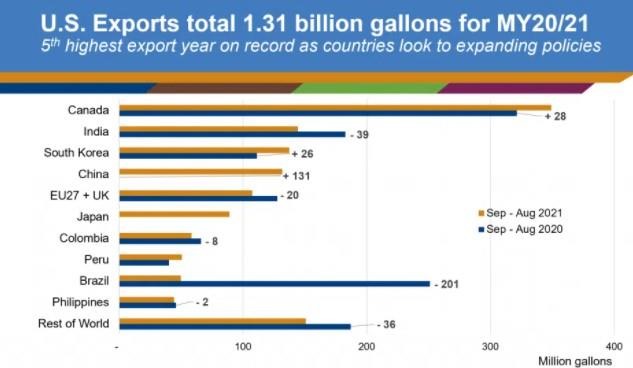
Exports were down eight percent from the previous marketing year, reflecting the challenges pandemic restrictions have had on fuel demand and trade. The first half of the year’s exports occurred before the issuance of widespread stay-at-home orders that drastically impacted demand for fuel around the globe.
While industrial exports remained strong, they sagged slightly relative to the surge of sanitizing application demand from the outset of the pandemic.
“The lingering effects of COVID-19 stay-at-home orders were reflected in global ethanol trade in the most recent marketing year,” said Brian Healy, director of global ethanol market development for the U.S. Grains Council (USGC). “Looking forward, more aggressive blend rates that have already been set, or will need to be set to meet emissions reduction goals, will support increased global ethanol demand and trade.”
In descending order, the top 10 export markets for U.S. ethanol were as follows:
Canada – Fuel ethanol demand recovered in Canada in the just-finished marketing year after being down by roughly 14 percent the prior year. Looking forward, the federal clean fuel standard, set to be implemented at the end of 2022 and geared toward reducing greenhouse gas (GHG) emissions, and provincial policy expansions like 15 percent renewable content in Ontario in 2025 are expected to drive future demand for ethanol.
India – The country is in the process of implementing an ambitious 20 percent policy by 2023, which, if realized and enforced, would more than double the fuel ethanol demand in the growing market. U.S. exports to India totaled 144 million gallons and were destined for industrial applications due to the restriction on fuel ethanol imports.
South Korea – Another strong industrial-use market, South Korea is currently exploring ways for the transport sector to reduce emissions, illustrated during the recent workshop held in early September. Exports totaled 137 million gallons, a 23 percent increase, reflecting the strategic position of the South Korean market as a transshipment point for Southeast Asian destinations.
China – While China’s 10 percent nationwide mandate was delayed, imports remained strong to meet the provincial policies in place. Ethanol has the potential to contribute to meeting additional China Phase One commitments as well as to support the country’s long-term emissions reduction goals set for 2060. China was the primary mover in the most recent marketing year, rising to the fourth-largest export market after having minimal exports in the two prior marketing years. Exports to China totaled nearly 132 million gallons.
European Union (EU) and the United Kingdom (UK) – Overall, exports to the EU and the UK were down from the prior year by 16 percent, as prices weighed on market access. In September, the UK began its E10 implementation with the expectation domestic capacity would be brought back online following full implementation of the policy.
Click here to see more...