Farms.com Home   News

United States Hog Inventory Down 1%

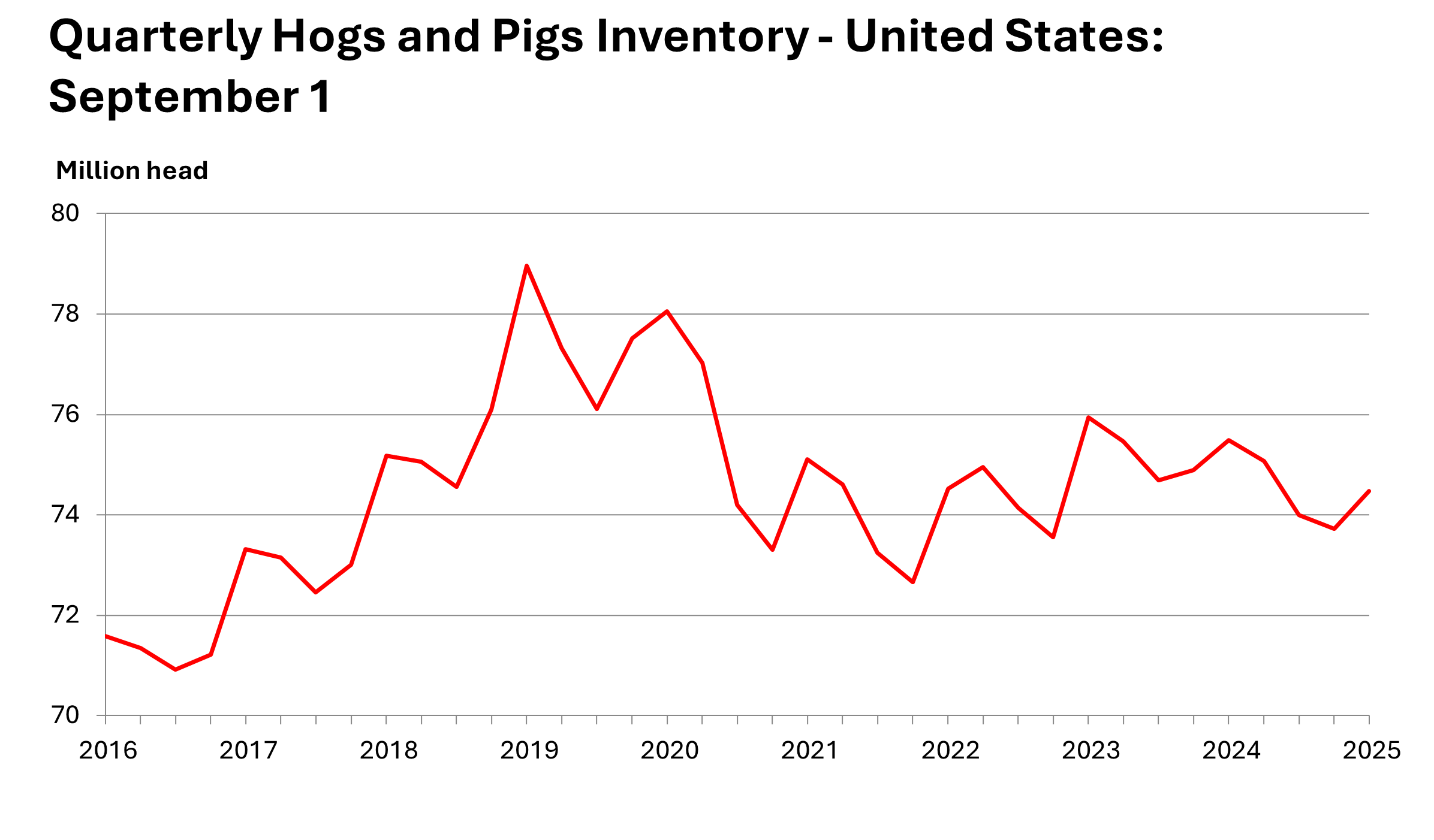
As of Sept.1, there were 74.5 million hogs and pigs on U.S. farms, down 1% from September 2024 but up 1% from June. 1, 2025, according to the Quarterly Hogs and Pigs report published today by the U.S. Department of Agriculture’s National Agricultural Statistics Service (NASS).
Crops

Other key findings in the report were:

  • Of the 74.5 million hogs and pigs, 68.5 million were market hogs, while 5.93 million were kept for breeding.
  • Between June and August 2025, 34.1 million pigs were weaned on U.S. farms, down 3% from the same time period one year earlier.
  • From June through September 2025, U.S. hog and pig producers weaned an average of 11.82 pigs per litter.
  • U.S. hog producers intend to have 2.86 million sows farrow between September and November 2025, and 2.82 million sows farrow between December 2025 and February 2026.
Source : usda.gov

Trending Video

How Swine Nutrition Can Revolutionize Biogas Production - Dr. Felipe Hickmann

Video: How Swine Nutrition Can Revolutionize Biogas Production - Dr. Felipe Hickmann


In this episode of The Swine it Podcast Show Canada, Dr. Felipe Hickmann from Laval University explores how nutritional strategies and manure management impact biogas production in pig farming. He breaks down the science behind anaerobic digestion at low temperatures and explains how dietary adjustments affect methane production and environmental sustainability. Learn how producers can reduce emissions and improve resource efficiency. Listen now on all major platforms!

"Lowering crude protein can reduce nitrogen in manure, but only if animal intake doesn’t compensate by increasing feed consumption."

Meet the guest: Dr. Felipe Hickmann / felipe-hickmann-963853a6 is a PhD research assistant at Laval University, specializing in swine and poultry sustainability. With extensive experience in manure management, nutritional strategies, and precision livestock technologies, he contributes to improving environmental outcomes in animal agriculture.