Farms.com Home   News

United States Hog Inventory Down 4%

As of Sept. 1, there were 75.4 million hogs and pigs on U.S. farms, down 4% from September 2020 but up 1% from June 1, 2021, according to the Quarterly Hogs and Pigs report published today by the U.S. Department of Agriculture’s National Agricultural Statistics Service (NASS).
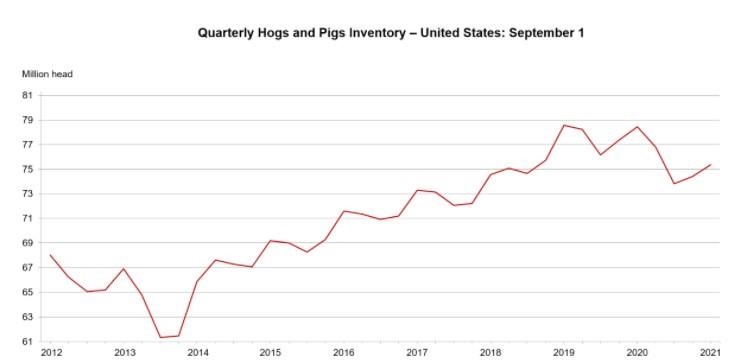
Hogs and Pigs report

Other key findings in the report were:

  • Of the 75.4 million hogs and pigs, 69.2 million were market hogs, while 6.19 million were kept for breeding.
  • Between June and August 2021, 33.9 million pigs were weaned on U.S. farms, down 6% from the same time period one year earlier.
  • From June through August 2021, U.S. hog and pig producers weaned an average of 11.13 pigs per litter.
  • U.S. hog producers intend to have 3.00 million sows farrow between September and November 2021, and 2.96 million sows farrow between December and February 2022.
  • Iowa hog producers accounted for the largest inventory among the states, at 24.4 million head. Minnesota had the second largest inventory at 9.00 million head. North Carolina was third with 8.30 million head.
Source : usda.gov

Trending Video

Finding a Balance of Innovation and Regulation - Dr. Peter Facchini

Video: Finding a Balance of Innovation and Regulation - Dr. Peter Facchini

Regulations help markets and industry exist on level playing fields, keeping consumers safe and innovation from going too far. However, incredibly strict regulations can stunt innovation and cause entire industries to wither away. Dr. Peter James Facchini brings his perspective on how existing regulations have slowed the advancement of medical developments within Canada. Given the international concern of opium poppy’s illicit potential, Health Canada must abide by this global policy. But with modern technology pushing the development of many pharmaceuticals to being grown via fermentation, is it time to reconsider the rules?

Dr. Peter James Facchini leads research into the metabolic biochemistry in opium poppy at the University of Calgary. For more than 30 years, his work has contributed to the increased availability of benzylisoquinoline alkaloid biosynthetic genes to assist in the creation of morphine for pharmaceutical use. Dr. Facchini completed his B.Sc. and Ph.D. in Biological Sciences at the University of Toronto before completing Postdoctoral Fellowships in Biochemistry at the University of Kentucky in 1992 & Université de Montréal in 1995.