By Laura Reiley
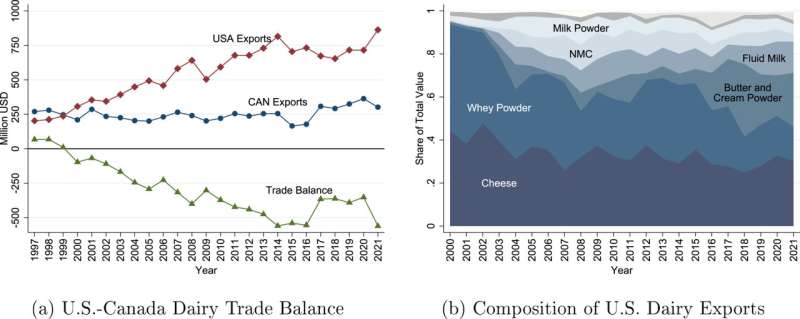
The United States and Canada have been fighting about milk for years, but new Cornell research suggests recent Canadian trade concessions removed some barriers to U.S. dairy exports.
Using monthly trade data, Christopher Wolf, the E. V. Baker Professor of Agricultural Economics in the Dyson School of Applied Economics and Management, in the SC Johnson College of Business, found that U.S. dairy exports to Canada increased after the 2020 U.S.-Mexico-Canada Agreement (USMCA), despite disgruntlement from all parties.
"Trade Protection Via Tariff Rate Quota Administration," which published in February in Food Policy, found that the USMCA dispute settlement mechanism worked effectively and efficiently to resolve trade disputes. Wolf is co-author along with K. Aleks Schaefer, associate professor of international markets, trade and policy at Oklahoma State University.
The North American Free Trade Agreement (NAFTA), which took effect in 1994, enabled a great deal of agricultural trade between Canada and the U.S., with a few notable exceptions. Among them: Canada maintained steep tariffs on dairy products, considering trade protection essential to its national dairy supply management program.
NAFTA was renegotiated into the USMCA under the first Trump administration, which opened the door on limited access to Canadian dairy markets beginning July 1, 2020. Still, the U.S. said the access was allocated was illegally restrictive. In January 2022, a USMCA dispute panel ruled that Canada had improperly restricted access to its market for U.S. dairy products.
Canada made changes, but the U.S. brought a second case to challenge them. In November 2023, a dispute panel sided with Canada, allowing it to continue to restrict the dairy access the U.S. sought.
At the time, members of Congress wrote a letter to then-U.S. Department of Agriculture Secretary Tom Vilsack, saying "Canada's unwillingness to provide fair market access harms U.S. dairy producers and processors."
The researchers assessed the economic outcomes associated with the dispute from the perspective of the U.S. dairy industry and found that, even under Canada's original quota administration procedures, Canadian concessions represented meaningful trade liberalization relative to pre-USMCA levels.
"Forty-three percent of U.S. dairy exports, by value, go to Canada or Mexico," Wolf said. "To Canada, it's a lot of butter, cream and higher-value products. Mexico is a big buyer of cheese. When we negotiated NAFTA, Canada said dairy was off the table. Canada had binding quotas to restrict production and keep prices up."
Click here to see more...