Learn about agriculture policy landscape, proactive self-regulation, and forward thinking
When it comes to political leadership, Parliament Hill is at the heart of where many debates and discussions take place that affect all Canadians. While most are familiar with the iconic scenes associated with the Parliament buildings, it is within those walls that policy decisions are made that drive this country. Ottawa was perfect backdrop for the fourth Advanced Agricultural Leadership Program (AALP) Class 16 seminar series that ran from February 28th to March 2nd, 2016.
While the House of Commons was not sitting during this time, this didn’t stop Member of Parliament, Will Amos of Pontiac, Quebec from extending a warm welcome to AALP Class 16. As a lawyer, primarily involved in championing environmental causes, Will Amos was looking to making a difference and recently transitioned into the political realm in the House of Commons. He shared his candid views and experiences as a relatively new Member of Parliament who has great interest in rural issues and is currently the vice-chair of the Liberal Rural Caucus. “Learning politics as a new MP is like drinking water from a fire hydrant,” stated Amos. Clearly, Amos is up for the challenge.
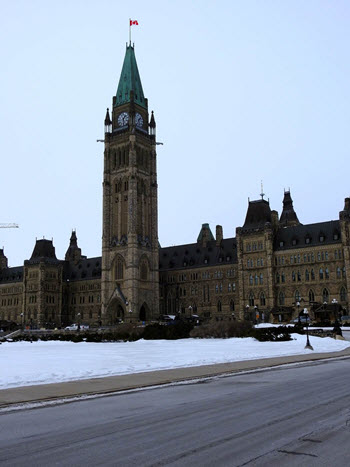
Later in the week, the class had the opportunity to walk the hallowed halls of Parliament Hill where Canada’s political leaders have shaped the country into what it is today. The visit included a group tour of Centre Block, East Block, the Peace Tower and Memorial Chamber.
This was a perfect segway into discussions about government relations. AALP graduates, Cathy Jo Noble, President of Noblepath Strategic Consulting Inc. of Ottawa and Julie Cayley, Principal of Julie Cayley Consulting of Barrie along with Chris George, Executive Council of Writing Services for CG&A Communications of Almonte shared their professional experiences both on Parliament Hill and at Queens Park. All three panel speakers reiterated the importance of clear, concise, targeted messages. “Know your MP and what will strike a chord. Give them a reason why they will want to champion your issue” stated Noble.
Hendrik Brakel, Senior Director, Economic, Financial and Tax Policy from the Canadian Chamber of Commerce enthusiastically highlighted the big economic, political and technological trends that will shape global business in 2016.
Brakel says “GDP growth will be driven by exports. The big issues are: skills and labour shortages across the board, infrastructure (trade enabling investments that improve productivity), environment and consultations (to get our resources to market), innovation and digital economy (start ups, venture capital, commercialization), trade (ratify TPP and CETA), taxes, CPP, EI and carbon taxes.”
Trade is of utmost importance and Canada ranks 5th in terms of exports. Trade negotiations including the Trans Pacific Partnership were discussed with Denis Landreville, Director for Trade Agreements and Negotiations, Directorate for Agriculture and Agri-Food Canada. Dennis Prouse, Vice President of Government Affairs with CropLife Canada emphasized that food challenges include drought resistance, salinity tolerance, pest pressures, improved input, increased vitamin content and elimination of key allergens will continue to be in the spotlight. “By 2030, 3.9 Billion people will live in water scarce areas. We also need to continue to lead in global discussions about low level presence of residues rather than zero tolerance,” says Prouse.
The current and future policy landscape for agriculture, proactive self-regulation and forward thinking are critical topics. Social licence requires that an activity enjoys sufficient trust and legitimacy, and has the consent of those affected. It is playing a significant role particularly with respect to food production.
“Consumers care about where their food comes from and want to influence how it is produced,” stated Scott Ross, Director of Business Risk Management and Farm Policy with the Canadian Federation of Agriculture. Clyde Graham, Senior Vice President from Fertilizer Canada added that when it comes to food production the use of fertilizer debates needs to shift from one of environmental harm to sustainability in order to meet the needs of feeding 9 billion people globally by 2050. Yves Leduc, Director of Policy and Trade shared how Dairy Farmers of Ontario is acting proactively with regards to social licence to address these needs.
Shannon Benner, Chief Executive Officer of 4-H Canada provided insight into leadership highlighting how the association is responding the challenge of maintaining heritage while maintaining it’s relevance to today’s youth. As well, Jack Doyle, General Manager from the Algonquin College Student’s Association provided the AALP Class with strategic management models for business. He reiterated the pitfalls associated with strategic planning citing that 95 percent of plans fail at the implementation stage.
The seminar series wouldn’t be complete without someone to challenge our way of thinking. Ken Knox, Chair of Science, Technology and Innovation Council accomplished that by having an interactive session that asked to consider how we can drive innovation in Canada and take advantage of opportunities.
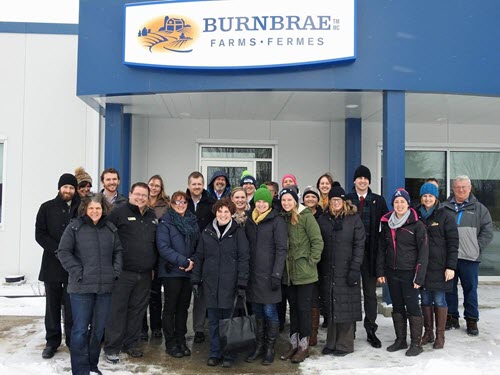
Additional tours included Burnbrae Farms Limited, one of Canada’s leading egg producers where AALP Class 16 was able to learn how consumer demands are influencing trends with respect to how eggs are produced and highlighted three different production barns outlining the advantages and disadvantages of all systems. Earl Stanley of Stanley’s Olde Maple Lane Farm, Edwards, ON showcased how he has built his farm into a major agri-tourism operation emphasizing maple syrup production.
“These sessions always provide great learning opportunities that simply can’t be found in any other program. The quality of speakers and breath of issues we are exposed to has broadened my understanding of agriculture”, said AALP Class 16 member Aaron Breimer. There is no doubt that this program is shaping the minds of future leaders in agriculture.