Fast food chain said there’s not enough Canadian beef to meet its standards
By Diego Flammini
Assistant Editor, North American Content
Farms.com
Fast food chain A&W is facing backlash from the ag community and others for its comments on sourcing Canadian beef.
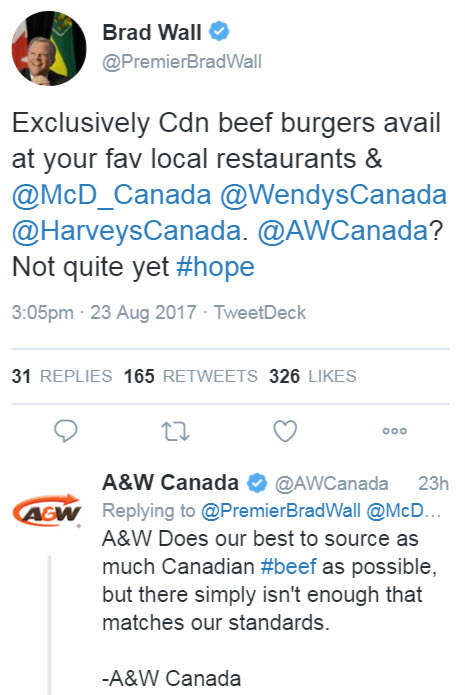
The exchange began with a tweet from Saskatchewan Premier Brad Wall.
His tweet said that Wendy’s, McDonald’s and Harvey’s all source their beef strictly from Canadian producers, and asked A&W if it would do the same.
In response, A&W tweeted yesterday that it tries to source as much Canadian beef as possible, but “there simply isn’t enough that matches our standards.” (In 2013, A&W introduced its “Better Beef” campaign and announced it would only source beef without any added hormones or steroids.)
Canadians responded quickly to this social media post and many people suggested they’ll no longer eat at A&W.
The ag community also defended beef producers and their practices.
“We have the highest standards of production for ourselves and our customers and firmly stand behind the quality and safety of our beef,” Brian Lemon, general manager of Manitoba Beef Producers, told Farms.com in an email today.
“Further, as an industry, we are happy to work with customers to meet the attributes they seek.”
And producers don’t believe that there’s a shortage of Canadian beef to meet A&W’s requirements.
“I’m thinking this is more of a marketing ploy than a comment on the Canadian beef industry,” Dan O’Brien, a beef producer from Greely, Ont., told Farms.com today.
“I’m sure if we had the product at a competitive price (for A&W), they would source it from Canadian producers.”
Producers also feel as if they’re in a no-win situation when it comes to elements like antibiotics.
“I think if people saw a sick steer, and I told them that with one needle I could make them feel better, I’m pretty sure they would see that as a good thing,” Phil Rodney, a beef producer from Lacombe County, Alta., told Farms.com today. “If you’re sick, you go to a doctor and they give you medication. It works the same way.
“If someone came out to the farm and it’s been a bad year for foot rot, and cows can hardly walk and I say I’m not going to treat them with anything, how does that make farmers look?”
People outside of the agricultural community also stood up for the country’s beef farmers.
For example, Suzette Leeming, chair of the Georgina Libraries in York County, Ont., said that if Canadian beef isn’t good enough for A&W, then the restaurant isn’t good enough for her.
“I’ve always been very proud of Canadian beef and Canadian dairy,” she told Farms.com today.
“I don’t think anybody will believe A&W. I think they’ve just shot themselves in the foot because other people will go to restaurants that serve Canadian beef. How do you plan to sell in a Canadian market and tell farmers their products aren’t good enough?
“They (A&W) don’t think Canadian beef is up to their standards? I just won’t go there anymore.”
Earls’ restaurant experienced similar backlash last year
A&W isn’t the only Canadian restaurant to have producers and consumers disagree with sourcing decisions.
The Earls’ chain of restaurants announced last year it would stop sourcing beef from Canada and instead import beef from Kansas as a way of serving what it called 100 per cent certified humane beef.
That decision caused farmers and consumers alike to boycott the restaurant, with the hashtag #boycottearls trending on Twitter.
Only about a week after its decision to source beef from Kansas, Earls’ changed its tune and said it would work with Alberta ranchers.
“We made a mistake when we moved away from Canadian beef,” Mo Jessa, Earls’ president, said in a video statement on May 4, 2016.
“We want to make this right. We want Canadian beef back on our menus so we are going to work with local ranchers to build our supply of Alberta beef that meets our criteria.”