Canada, the U.S., and Mexico welcome the world’s best soccer players this summer
In less than a month, the world’s best soccer players from 48 countries will descend on North America to participate in the FIFA World Cup in Canada, the United States, and Mexico.
Ultimately the goals on the pitch (grown by sod farmers) will decide each country’s fate in the tournament.
But what if each country’s ag sector provided the winning (or losing) metrics?
With that at top of mind, Farms.com created a full 2026 FIFA World Cup bracket using available economic data related to the 48 participating countries.
In this tournament, countries with larger shares of agriculture as part of the national GDP are considered winners.
The Farms.com World Cup will follow the FIFA format – the top two teams from each group, plus the eight best third-place teams, will advance to the knockout stages.
GW – Group Winner
RU – Runner Up
TP - Third Place
Here are the groups.
Group A | Group B | Group C | Group D | Group E | Group F |
Mexico (RU) | Canada | Brazil (TP) | USA | Germany | Netherlands |
South Africa (GW) | Bosnia and Herzegovina (GW) | Morocco (RU) | Paraguay (GW) | Curacao (TP) | Japan (TP) |
South Korea | Qatar (RU) | Haiti (GW) | Australia (TP) | Ivory Coast (GW) | Sweden (RU) |
Czechia | Switzerland | Scotland | Turkey (RU) | Ecuador (RU) | Tunisia (GW) |
Group G | Group H | Group I | Group J | Group K | Group L |
Belgium | Spain | France | Argentina (TP) | Portugal | England |
Egypt (GW) | Cape Verde (GW) | Senegal (GW) | Algeria (GW) | DR Kongo (GW) | Croatia |
Iran (RU) | Saudi Arabia (TP) | Iraq (RU) | Austria | Uzbekistan (RU) | Ghana (GW) |
New Zealand | Uruguay (RU) | Norway (TP) | Jordan (RU) | Colombia (TP) | Panama (RU) |
With the group stage settled, here is how the rest of the ag World Cup bracket would shape up.
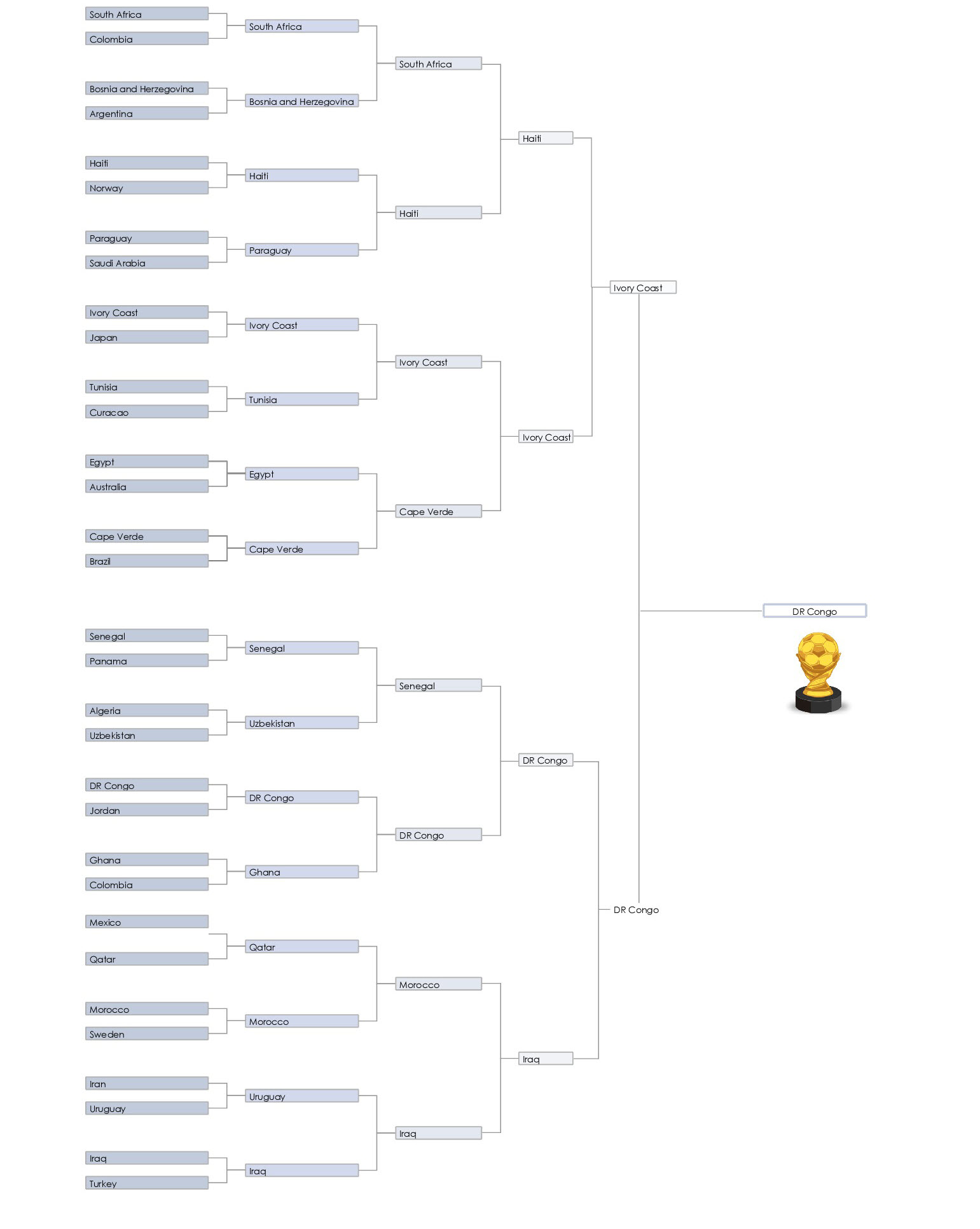
Based on the data available, the Democratic Republic of the Congo would win the 2026 FIFA World Cup if ag as a percentage of national GDP predicted the winners.
Data from The Global Economy estimates the ag sector in the country represented on average about 21 percent of the DR Congo’s GDP between 1994 and 2024.
The top ag commodities produced in the country include cassava, plantains and bananas, corn, rice, and palm oil.
Farmers mainly grow these crops in a subsistence farming operation, which is growing food only to feed one’s family.
The country exported more than $400 million of agri-food products in 2024, supported by high prices for cocoa and coffee.