By Laura Lindsey, Steve Culman
Sulfur is an essential macronutrient for crop production, often ranked behind only nitrogen, phosphorus, and potassium in importance. Overall, for corn and soybean, deficiencies are fairly rare. However, deficiencies can occur and are most likely on sandy soils with low organic matter (<1.0%). Much like nitrogen, the primary form of sulfur in the soil is found in the organic fraction, and the form taken up by plants (sulfate) is highly mobile. For every 1 percent of organic matter, there is approximately 140 pounds of sulfur, most of which is unavailable. Like nitrogen, sulfur must be mineralized to become plant available. (Plants may exhibit sulfur deficiencies under cool, wet conditions when mineralization is slow.) Historically, sulfur was deposited in large quantities from rainfall primarily due to burning of fossil fuels. However, emission standards have resulted in a sharp decrease in sulfur deposition from the atmosphere. As this trend continues, coupled with higher yielding crops, sulfur fertilization may become more important in the future.
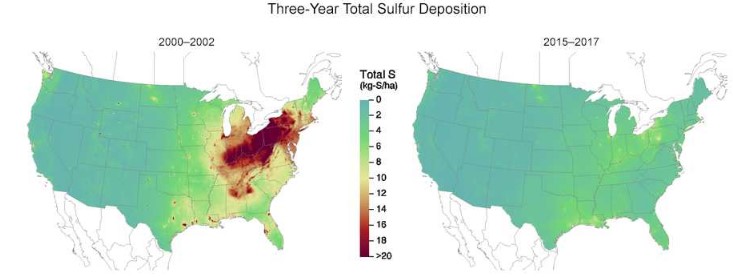
Figure 1. Sulfur deposition maps from 2000-2002 and 2015-2017 (USEPA, 2019).
A common question these days, is ‘Do I need to fertilize with sulfur?’ Table 1 summarizes on-farm sulfur trials conducted in Ohio from 2016 through 2019. Overall, only one trial (out of eight) resulted in a yield increase due to sulfur application (3 bu/acre in soybean). In addition to these on-farm trials, sulfur (applied as gypsum) did not increase yield in sixteen different environments across Ohio in studies conducted in 2013 and 2014. Lack of yield response is likely due to soils with organic matter levels >1%. (In our sixteen-environment study, soil organic matter levels ranged from 2.0 to 5.1%).
Table 1. Summary on on-farm sulfur trials in corn and soybean from 2016-2019.
Year | County | Crop | Sulfur Source, Rate, and Timing | Yield Response? | Reference |
2019 | Madison | Soybean | Thio-sul at V3 | None | Nate Douridas (eFields report) |
2019 | Crawford | Soybean | Thiosulfate, 20 lb S/acre, starter | +3 bu/acre | Jason Hartschuh (eFields report) |
2019 | Darke | Soybean | AMS, R1 and R3 | None | Sam Custer (eFields report) |
2018 | Darke | Corn | Starter | None | Sam Custer (On-Farm Report) |
2017 | Darke | Corn | Starter | None | Sam Custer (On-Farm Report) |
2017 | Darke | Corn | Ammonium thiosulfate, 20 and 40 lb S/acre, starter and sidedress) | None | Sam Custer (On-Farm Report) |
2016 | Muskingum | Corn | Starter | None | Clifton Martin & Van Slack (On-Farm Report) |
2016 | Darke | Corn | Starter | None | Sam Custer (On-Farm Report) |
Sulfur deficiency symptoms are similar to nitrogen, but unlike nitrogen, chlorosis (yellowing) is more visible on newer, upper leaves. If you think your crop is deficient in sulfur, plant tissue testing is the best way to assess. (Sulfur soil analysis is not recommended.) If possible, collect plants exhibiting deficiency symptoms and also plants not exhibiting deficiency symptoms for comparison.
Source : osu.edu