By Peter Tomlinson and Dorivar Ruiz Diaz
The use of poultry litter can contribute to reducing the cost of fertilizer inputs for many operations, depending on the price and transportation cost of the litter. For many farmers, the use of poultry litter may represent significant savings particularly in times of high fertilizer prices. However, for many producers there is a “hassle factor” with using poultry litter. Reliable delivery, storage site location, uniform application, access to application equipment, and odor can all be additional challenges to producers unfamiliar with its use and should be a consideration.
Calculating poultry litter value
How valuable is poultry manure? This may not be a straightforward answer and depends on several factors, including the nutrient(s) required for a specific field. Here is one example using the average nutrient analysis values from southeast Kansas of 56-53-46 (N-P2O5-K2O lb per ton) :
Year 1
- 35% of N is inorganic (all available) = 19.6 lb N/ton litter
- 65% of N is organic (25% is available in year 1) = 9.1 lb N/ton litter
- Total N available in year 1 = 28.7 lb N/ton litter
- Total value of N available in year 1 (@ $0.85/lb N) = $24.40/ton litter
- P is 50% available in year 1 = 26.5 lb P2O5/ton litter
- Total value of P in year 1 (@ $0.85/lb P2O5) = $22.52/ton litter
- K is 100% available in year 1 = 47.0 lb K2O/ton litter
- Total value of K in year 1 (@ $0.39/lb K2O) = $18.33/ton litter
- Total in year 1 = $65.25/ton litter
- Residual N and P = $45.73/ton litter
More information on nutrient availability in poultry manure is available online in eUpdate Issue 881 at https://bit.ly/3wHffD8. In addition to the N, P, and K, poultry litter also contains sulfur, micronutrients, and organic matter which adds additional value to the poultry litter.
Storage considerations
Proper storage of manure is important to prevent runoff contamination of water and odor problems. The following practices should be utilized:
- Avoid stockpiling litter near homes, public roadways, and drainage ditches.
- Stockpile litter at least 200 feet away from “Waters of the State.”
- Use tarps on litter piles to keep litter dry, reduce odor, and reduce N losses from volatilization.
- Create an earthen berm around piles to allow time for water and nutrients running off the pile to infiltrate.
Additional considerations when selecting a suitable storage site
- Locate stockpiles in areas with minimal slope.
- Avoid sites that slope toward waterways and receive extraneous drainage.
- Locate sites in areas surrounded by grass that can serve as a buffer.
- Avoid sensitive groundwater areas and sites in close proximity to wells.
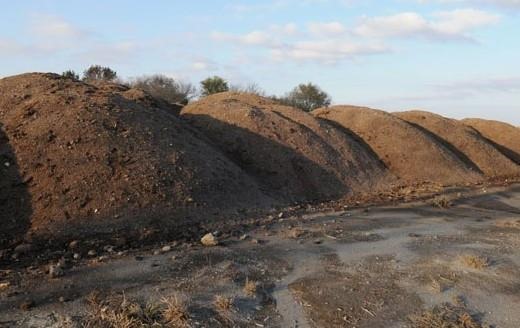
Figure 1. Poultry litter stockpiles. Photo by Dan Donnert, K-State Research and Extension.
If poultry litter is a regular part of your operation’s fertility program, consider constructing improved poultry litter storage sites that include a storage pad built out of lime screenings, all-weather truck access, and a grass or cropland buffer to trap nutrients leaving the storage site. K-State Research and Extension Watershed Specialists may be able to help in identifying suitable storage locations and/or designing improved temporary storage sites that poses the least possible environmental risk from runoff for the area.
Source : ksu.edu