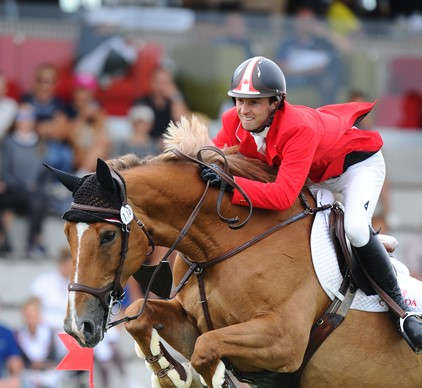
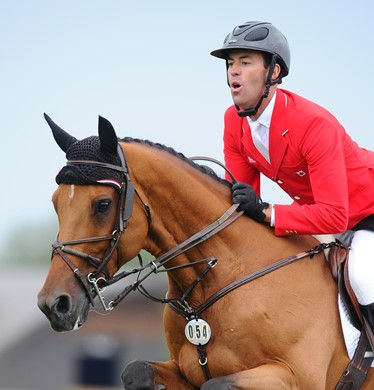
The Canadian Show Jumping Team fielded a group of developing riders for the Nations’ Cup event held Friday, September 1, at CSIO3* Samorin, Slovakia. Francois Lamontagne of Saint-Eustache, QC, team anchor Jonathon Millar of Perth, ON, Wesley Newlands of Toronto, ON, and Brian Walker, residing in Wellington, FL, finished seventh among the 11 countries battling for victory.
Making his Canadian Show Jumping Team debut, pathfinder Walker, 33, posted a clear round riding Carlson 93, a nine-year-old bay Hanoverian gelding (Contendro I x Stolzenberg) owned by the Carlson 93 Syndicate LLC, to get the opening round off to a strong start for Canada.
Newlands, 29, was next in for Canada, also donning the iconic Canadian Show Jumping Team red coat for the first time. With Wieminka B, a 14-year-old grey Dutch Warmblood mare (Cardento x Topas) owned by Weslands Farm, Newlands delivered another clear round for Canada to keep the scorecard at zero.
Lamontagne, 33, was making his second Nations’ Cup appearance, having previously represented Canada in 2012 in Buenos Aires, Argentina. Riding Chanel du Calvarie, his nine-year-old chestnut Belgian Sport Horse mare (Luccianno x Kashmir van Schuttershof), Lamontagne also kept all the rails in place over the track set in the expansive grass arena to give Canada its third clear round.
Jonathon Millar, 42, riding in the anchor position as a veteran member of the Canadian Team, could not improve upon his country’s perfect score, but opted to jump with Bonzay, an 11-year-old Dutch Warmblood gelding (Numero Uno x Heartbreaker) owned by Isotropic Networks Inc. The pair’s 12 faults were dropped, as only the best three scores are counted towards the team total in Nations’ Cup competition.
Coming back for the second round, Canada sat atop the leaderboard, tied for first place with Brazil who had also kept a clear scorecard. Italy was lying third with four faults, while France, Japan, Germany and the United States were tied for fourth place with eight faults apiece. The home team from Slovakia as well as Austria, the United Arab Emirates, and Morocco failed to qualify for the second round.
Canadian fortunes changed drastically in the second round, however, when all four team members posted a score of eight faults. Forced to count a total of 24 faults in the second round, Canada dropped down to seventh place in the final standings.
Tied on eight faults apiece, Brazil and Germany jumped off to determine the winner. Marlon Zanotelli was clear with Celena VDL to secure victory for Brazil after Germany’s Jorne Sprehe faltered for four faults riding Stakki’s Jumper. Italy finished third with a two-round total of 12 faults.
“We were outstanding today in the first round of the Nations’ Cup in Samorin, and were leading the class going into round two,” said Canadian Show Jumping Team chef d’équipe Mark Laskin of Langley, BC. “Our riders rode with accuracy, confidence, and calmness, which belied their lack of experience in Nations’ Cup competition.
“Unfortunately, the second round didn’t go as well for us, but this is a developing group and the purpose of this tour is for our riders to acquire Nations’ Cup experience,” continued Laskin. “Hopefully, they will have learned the lesson and be better next time.”
Up next for the Canadian Show Jumping Team is Nations’ Cup competition on Saturday, September 2, in Gijon, Spain, where Yann Candele, Kara Chad, Jaclyn Duff and Chris Pratt will battle against eight other countries. One week later, Mario Deslauriers, Eric Lamaze, Ian Millar and Keean White will take up the challenge on home soil in the $400,000 BMO Nations’ Cup on Saturday, September 9, at the CSIO5* Spruce Meadows ‘Masters’ tournament in Calgary, AB.