By Erin Hodgson and Ashley Dean
With several severe weather events in Iowa this month, reports of lodged corn are coming our way. Often times, a small part of the field is flattened and would be difficult to see from the edge. I encourage you to get out into cornfields and see how your stands look this month. In some cases, using a UAV camera to scan large fields is helpful. Evaluating root injury and adult activity is helpful for determining future management decisions.
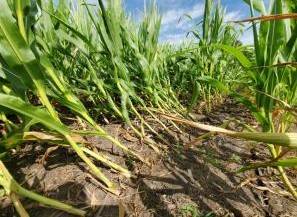
Look for patches of lodged plants within cornfields.
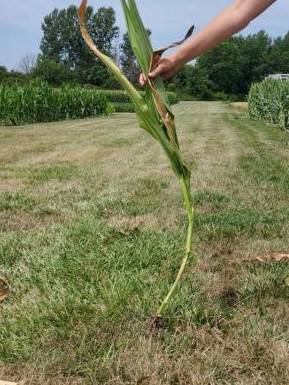
Classic goosenecking injury caused by corn rootworm larvae.
In most cases, Bt traits are included in these fields with severe root injury. Continuous corn production fields are more likely to have economic injury from corn rootworm. Larval feeding can consume most of the roots and interfere with nutrient and water uptake; plus compromised roots make plants unstable in inclement weather.
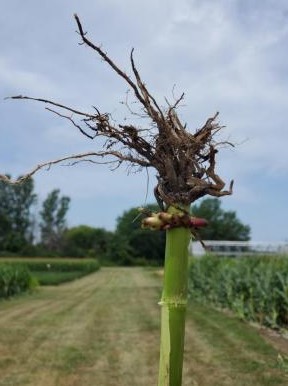
Severe root injury directly translates to yield losses.
Source : iastate.edu