By Brian Lang and Rebecca Vittetoe
Every spring, alfalfa growth and development differs due to variations in climatic, variety, stand age and other crop production factors. With the 2020 growing season being off to a cooler than normal start, alfalfa growth is also off to a slower start this spring. This is a good reminder that while calendar date is one method used to determine when to harvest first crop alfalfa, it is not the best method to use. Instead, the PEAQ method (Predictive Equations for Alfalfa Quality) developed by the University of Wisconsin does a better job.
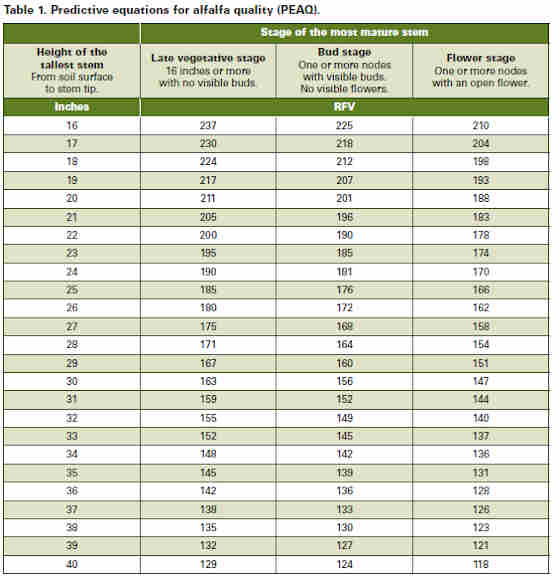
The PEAQ method uses alfalfa stand height and maturity stage (vegetative, bud, or bloom) to estimate the relative feed value (RFV). In general, it is recommended to harvest alfalfa at about 150 RFV for first trimester dairy and calves, 135 for stocker cattle, and 120 for lactating beef cattle. First crop alfalfa standing in the field can drop three to five points of RFV per day. The steps on how to use the PEAQ method to determine when to make the first crop of alfalfa are listed below.
Note that while PEAQ does a good job of estimating the RFV, under the best harvest conditions 10-20% of the forage dry matter will be lost at harvest. This amounts to approximately 15 RFV points for haylage and 25 RFV points for hay. Therefore, to end up with 150 RFV alfalfa, harvest the crop when PEAQ measurements estimate a RFV of 165 for a haylage harvest and 175 for a hay harvest. And, of course, take into account the weather forecasts. Don’t wait on a little more stem growth if it’s going to cause a rain delay.
Steps for using PEAQ to determine when to take first crop alfalfa
Step 1. Choose a representative two square foot area in the field.
Step 2. Determine the stage of the most mature stem in the area by using the definitions at the top of Table 1.
Step 3. Measure the tallest stem in the area. The tallest stem may not be the most mature stem. Measure the stem from the soil surface to the tip of the stem; not to the tip of the leaf. Straighten the stem for an accurate height measurement. Based on stem maturity and stem height, use Table 1 to estimate the RFV of standing alfalfa crop.
Step 4. Repeat steps 1-3 in five representative areas across the field.
Step 5. To estimate harvest quality, subtract 15-25 RFV units to account for harvest losses during the haylage or hay harvest process, respectively.
Step 6. Determine optimum harvest time using the PEAQ estimate, livestock forage quality needs, considerations of upcoming weather forecasts favorable for harvest, and the general assumption that RFV drops three to five points per day.
ISU Extension maintains a PEAQ website that includes a fact sheet to explain how to use the PEAQ method to determine when to harvest first crop alfalfa. This website also includes postings of PEAQ values from some alfalfa fields across Iowa being monitored by ISU Extension and Outreach staff. Follow the progress in these reports but remember conditions can vary field-by-field. Therefore, it is recommended to take PEAQ measurements in your own fields to best estimate first crop harvest to help target the quality of forage you wish to achieve.
Source : iastate.edu