By Hannah Lepsch
Most North Carolina gardeners will need to amend their soil with lime at some point. A typical Piedmont soil is naturally acidic and requires liming to neutralize excess acidity. Proper liming raises soil pH to the optimum 6.0-7.0 range for most plants. It enhances nutrient availability, promotes plant and root health, and supplies the necessary calcium (Ca) and magnesium (Mg) to plants. Because the effects of liming diminish over time, soil needs to be re-tested and lime re-applied every three years or so. Lime is a mined product that can be used in organic farming. Calcitic and dolomitic lime are the two main types used in agriculture and gardens. Both contain calcium and are equally effective in raising pH, but dolomitic lime supplies additional magnesium. Dolomitic lime is recommended for sandy soils and when a soil test shows that magnesium is deficient. Calcitic lime is more beneficial if you have issues with blossom end-rot.
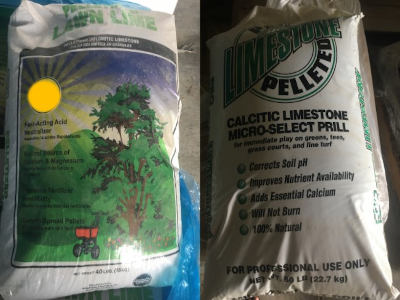
Dolomitic (left) and calcitic (right) liming material.
Not all liming materials are created equal. Materials vary in how quickly they neutralize soil acidity and application ease. Ground, pelletized, and liquid lime are widely available forms of lime.
Ground lime, also called ag lime, is the cheapest form and is used widely in production farming. Its drawback is that it is dusty and hard to spread. Pelletized or granular lime is ground lime in a pelleted form. It is recommended for lawns and gardens because it is easy to spread and achieve even coverage. Liquid lime consists of ground lime suspended in water. It is the most costly, easy to use, and fast acting, but tends to have short-lived effects and must be re-applied every year.
Fall is an excellent time to test your soil and apply lime. It takes time for lime to change soil pH so apply well in advance of planting time, a minimum of three months. For fastest results, till or incorporate with hand tools to the rooting depth, and water in after applying.
Have your soil tested to determine whether you need lime and how much to apply. Soil pH can be either too low or too high in different soil types, and it is important not to assume you always need to add lime to your soil. A recommended lime rate is provided on a soil test report. Soil test kits can be picked up at your local Extension office. Don’t miss your opportunity to get FREE soil testing before Dec 1!
Source : ncsu.edu