By Glenn Selk,
The months of April and May are traditionally the time when “spring roundups” take place. This is the time that large and small cow/calf operations schedule the “working” of the calves. As the majority of the calves reach their second month of life, it is time to castrate the male calves (if this has not already been done) and immunize all of the calves to protect them against blackleg. In some situations, calves may be vaccinated for the respiratory diseases, i.e. IBR and BVD. Check with your large animal veterinarian about these immunizations.
Injection BQA
Correct administration of any injection is a critical control point in beef production and animal health. There is a negative relationship between meat tenderness and injection sites, including injection sites that have no visible lesion. In fact, intramuscular (IM) injections, regardless of the product injected, may create permanent damage regardless of the age of the animal at the time of injection. Tenderness is reduced in a three-inch area surrounding the injection site. Moving the injection-site area to the neck stops damage to expensive steak cuts. Therefore, cow/calf producers should make certain that their family members, and other hired labor are sufficiently trained as to the proper location of the injections before the spring calf-working begins.
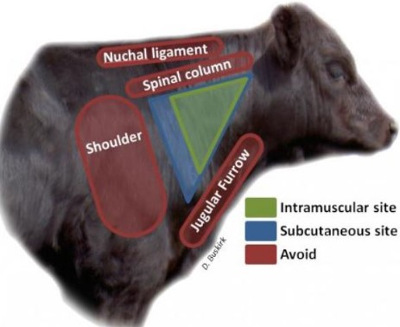
Give injections according to label instructions. Subcutaneous (SQ) means under the skin, intramuscular (IM) means in the muscle. Some vaccines (according to the label instructions) allow the choice between intramuscular (IM) and subcutaneous (SQ). Always use subcutaneous (SQ) as the method of administration when permitted by the product’s label. Remember to “tent” the skin for SQ injections, unless instructed otherwise by the manufacturer. Proper injection technique is just one of many components of the Beef Quality Assurance effort that has had a positive impact on the entire United States beef industry.
Medication Record BQA
Another important aspect of the Beef Quality Assurance effort is keeping of accurate treatment records. Treatment records should include:
- Individual animal/group identification
- Date treated
- Product administered and manufacturer’s lot/serial number
- Dosage used
- Route and location of administration
- Earliest date animal(s) will have cleared withdrawal period
- Name of person administering the product
Treatment records for cattle should be stored and kept for a minimum of three years after the animal(s) have been sold from your operation.
Beef producers are encouraged to learn and practice Beef Quality Assurance Guidelines. You can learn more about the Beef Quality Assurance program by going to the website: https://www.bqa.org/ The Beef Quality Assurance Manual can be downloaded from that site. Examples of treatment records to be kept and stored are available from the Beef Quality Assurance Manual: BQA Medication & Treatment Records
Source: ufl.edu