By Seth Naeve and David Nicolai et.al
What a difference a year (or two) can make. This year's spring planting conditions have been a real blessing for most Minnesota farmers after two absolutely miserable planting seasons. Where conditions were good, farmers were ready to take advantage of the extended period of warm and dry weather at the end of April.
The May 4 USDA-NASS Crop Progress report showed Minnesota corn acreage to be 76% planted. Only Iowa and North Carolina had larger fractions of corn planted at 78 and 79%, respectively. The average planting rate for Minnesota over the past five years was 36%. Minnesota soybeans were 35% planted compared with 10% in the previous five years.
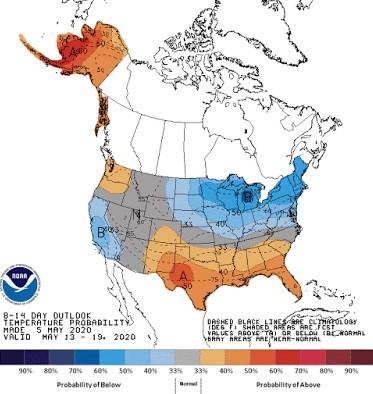
However, weather patterns have changed, and the Northwest winds have been blowing. High temperatures in the 50's have arrived, and they look to hang around for a week or so. More concerning for farmers, however, is the forecast for lows in low 30’s and even high 20’s. The impact of these low lows is dependent on stage of the crop - emerged, recently planted, or in the bag. Let’s discuss these three scenarios.
Emerged crop
According to this week’s USDA-NASS report, 3% of the Minnesota corn crop was emerged prior to May 4. A negligible amount of soybeans had emerged by this date. In subsequent days, emerged corn and soybean acres have increased. However, cooler temperatures will now reduce the rate of emergence of these crops. Planted corn and soybean fields will continue to progress through this week of cool temperatures, but rate of the “pop” will definitely slow.
So, how will low temperatures expected late this week and early next week affect emerged corn and soybean crops? Undoubtedly, you will hear lots of hard numbers about temperature and duration of cold temperatures on frost damage to crops. Generally, temperatures usually need to be at or below 28 to 30 degrees Fahrenheit for several hours. From a practical standpoint, there are so many mitigating and compounding factors, that pointing to specific temperatures is impractical. Below is a list of some important factors that impact spring frost damage to emerged crops.
Crop
Corn - exhibits hypogeal emergence, whereby the seed and growing point remain below the soil surface for several weeks after emergence. Because the growing point is below the surface, extreme hard freezes are required for plant death. Frost damage to exposed leaves has little impact on potential corn yields, especially at very early dates. “Lethally cold” temperatures for emerged young corn plants are those that dip to 28 degrees or lower for 1 to 2 hours.
Soybean - exhibits epigeal emergence whereby the cotyledons are pushed out up through the soil surface. This exposes the growing point to the atmosphere and puts the crop at a greater risk of frost damage.
Sugarbeet - seedlings possess more ability to cold-harden and may tolerate freezing temperatures better than soybean. Sugarbeet at the cotyledon stage seem to tolerate cold temperatures better than 2-leaf sugarbeet or seedlings just beginning to emerge from soil. The stem is particularly susceptible to ice damage at this time and a soil temperature (not air temperature) at 31 F at the ½ inch depth may be lethal. Sprouting seeds contain only a small amount of water and ice crystals will not form because of the relative high content of dissolved materials.
Type of tissue exposed
As soybeans emerge through the soil surface, their thick high-moisture tissues are highly resistant to frost damage. The water helps maintain internal temperatures during short frost events. As the hypocotyl extends over days and the cotyledons stretch upward, they will open and expose the developing unifoliolate leaves. This fragile tissue is the functional growing point of the soybean and can be easily damaged by periods of sub-freezing temperatures. Fortunately, it is common for soybean to produce new growing points from the axils of the cotyledons if the unifoliolate is damaged.
Boundary layer
The soil surface is heated during the day and will retain this heat through the night under normal nighttime conditions. Increased winds reduce the boundary layer and allow the soil surface to chill which increases the risk of frost damage. Surface roughness also affects the boundary layer. Heavy residue, such as standing cornstalks in no-till, greatly increases the boundary layer and can help protect the crop in marginal frost conditions.
Soil moisture
Water has a very high thermal mass, meaning that it efficiently absorbs, stores, and releases heat. This is an incredibly helpful physical property for defending against frost as the soil moisture will allow the soil surface to remain far above freezing even when ambient temperatures - that are measured above the soil surface - plunge. Fields that have received recent rainfall and have sufficient soil moisture will be more frost resistant than those where soil moisture levels have been drawn down with tillage and warm sunny weather conditions.
Topography
Low-lying areas of fields tend to be affected by frost damage the most simply due to lower temperatures experienced in these portions of the landscape.
Recently planted crops
Recently planted corn and soybean crops should perform fine through this cool snap. As mentioned above, emergence will slow, thus reducing the risk of frost damage to the emerged crop. Cool temperatures will provide a longer window for farmers to make their pre-emergence herbicide applications.
Seed in the bag
Farmers with corn and soybean in the bag simply need to look for good soil conditions to get rolling. One should not be concerned about cool ambient temperatures. It’s time to get the crop planted, so do not miss opportunities to get to the field when working conditions are suitable.
Source : umn.edu