With climate change, irrigating more crops in the United States will be critical to sustaining future yields, as drought conditions are likely to increase due to warmer temperatures and shifting precipitation patterns. Yet less than 20% of croplands are equipped for irrigation.
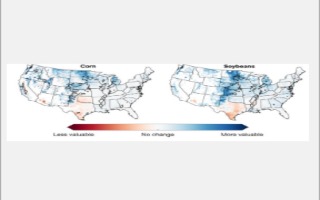
A Dartmouth-led study finds that by the middle of the 21st century under a moderate greenhouse gas emissions scenario, the benefits of expanded irrigation will outweigh the costs of installation and operation over an expanded portion of current U.S. croplands. The results show that by mid-century corn and soybeans that are currently rainfed would benefit from irrigation in most of North Dakota, eastern South Dakota, western Minnesota, Wisconsin, and Michigan. Soybean farmland that relies on rain throughout parts of Indiana, Illinois, Ohio, Kentucky, Kansas, and Oklahoma would also benefit from irrigation. The findings are published in Communications Earth & Environment, an open-access journal from Nature Portfolio.
Installing, maintaining, and running irrigation equipment comes at a significant cost to farmers, as much as $160 per acre per year. "Our work essentially creates a U.S. map of where it will make the most sense to install and use irrigation equipment for corn and soybean crops in the future," says first author Trevor Partridge, a Mendenhall Postdoctoral Fellow and research hydrologist with the U.S. Geological Survey Water Resources Mission Area, who conducted the study while working on his PhD at Dartmouth.
The High Plains region, including Nebraska, Kansas, and northern Texas, has historically been one of the most heavily irrigated areas, and was found to have the highest current economic returns for irrigation. However, the increasing costs of drought are pushing farmers to invest in irrigation throughout regions of the Corn Belt and southeastern U.S., and the long-term economic return on these investments is difficult to predict.
To conduct the cost-benefit analysis of irrigating corn and soybeans, the researchers ran a series of crop model simulations. They applied several global climate projections that span the range of potential future climates—hot and dry, hot and wet, cool and dry, cool and wet, each relative to the average climate projection—to simulate future crop growth under fully irrigated or rainfed conditions.
For each climate scenario, the crop model was run for both corn and soybeans across all cultivated areas in the U.S. The crop model simulations examined three periods: historical (1981-2010), mid-century (2036-2065), and end-of-century (2071-2100) under moderate and high greenhouse gas emissions scenarios. The simulations factored in county-level crop management and growth data from the U.S. Department of Agriculture National Agricultural Statistical Service, including planting, maturity, and harvest dates.
To determine the economic benefits of irrigating—the team calculated the additional simulated crop yield from irrigating and the corresponding increased market value that could be expected—relative to the irrigation costs, which included the electricity required to pump groundwater and distribute it over the field, and associated expenses per acre to own and operate the irrigation system.
The team investigated not only where and when it makes sense to install irrigation for corn and soybeans but also if there will be enough water to do so. They calculated the "irrigation water deficit," which is the simple difference between how much water is applied to the field relative to how much water should be available for irrigation.
The results show that by mid-century there will likely be enough water to irrigate soybeans in Iowa, Wisconsin, Ohio, and northern Illinois and Indiana, but not corn. Iowa is the largest producer of corn in the U.S. Groundwater resources for irrigation were found to be the most abundant in the southeast U.S., especially in the lower Mississippi Valley where agriculture is less intensive. However, in this region the benefits of irrigation are minimal.
"Our results suggest that there is relatively little overlap between where there is enough water to fully irrigate crops without placing additional stress on water resources and where farmers can expect the investment in irrigation to pay for itself over the long term, " says Partridge.
For example, the Ogallala Aquifer in the Great Plains is the largest aquifer in the U.S., providing water to eight states, and supports one the most extensively irrigated areas for corn and soybeans.
"The increasing benefits of irrigation, could incentivize farmers to use more water, which will place additional stress on key aquifers, including the Ogallala," says senior author Jonathan Winter, an associate professor of geography and lead of the Applied Hydroclimatology Group at Dartmouth. Prior research has shown that water is being extracted from the Ogallala Aquifer faster than it can be replenished. "There's just not enough water to continue irrigating at the current rate from the Ogallala, especially in the southern portion where groundwater levels are rapidly falling," says Winter.
Click here to see more...