Farms.com Home  › News

Is Downy Mildew Taking a Bite of Your Lettuce Crop?

Is Downy Mildew Taking a Bite of Your Lettuce Crop?

By Leah Fronk

However, when growing lettuce in a protected setting during the colder months, downy mildew can affect the yield and quality of lettuce.

Lettuce downy mildew (DM), Bremia lactucae, is favored in cool, moist environments, often found in low tunnels or greenhouses in late fall and winter. Lettuce downy mildew is caused by a fungal-type organism, an oomycete, that enjoys damp, wet conditions. Growers may notice white fuzzy sporulation on the underside of the leaves, which could be easily mistaken for powdery mildew. Primary symptoms of lettuce downy mildew include leaf yellowing in angular patches. Yellow patches observed on the upper leaf surface may correlate with white sporulation on the lower leaf surface, as shown in the photo. The yellow patches turn brown and papery as the disease progresses, and the leaf tissue dies. Discoloration of red leaf lettuce may appear more gray than yellow. Older, mature leaves are usually the first to show symptoms of DM. Damaged leaf tissue may allow for the entry of secondary pathogens, reducing yield and making lettuce quality worse.
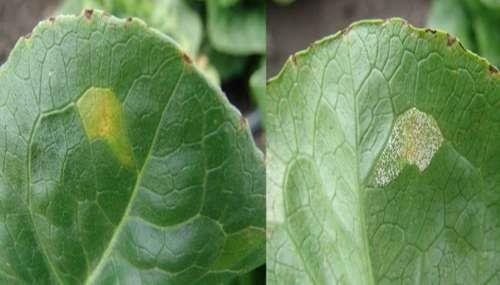
Composite photo showing both sides of the same leaf

Composite photo showing both sides of the same leaf.


Cucurbit downy mildew is caused by a different causal agent than lettuce downy mildew. Spinach is affected by yet another downy mildew organism. When growers observe lettuce downy mildew in protected cultures, they should not blame the occurrence of cucurbit downy mildew debris in fields. Downy mildew can be persistent in overwintering spores or blown in from other regions. The role of seed contamination associated with downy mildew is not certain.

As with many plant diseases, prevention is the best strategy. Use the heater and vents in the greenhouse to remove moist air. Employ irrigation practices that reduce leaf wetness. Fungicides are available that are oomycete-specific. A few conventional products available for greenhouse use include Tanos, Ranman*, Curzate, Aliette, Fontelis, and Sonata. Some fungicide products can be tank-mixed with copper to increase protection (*Do not tank-mix Ranman with copper-based fungicides, or plant injury may be observed).

Rotate modes of action so that the pathogen does not become resistant to the fungicides you are using. Organic options include Stargus, Cease, Actinovate, and copper. As with the application of any product, conventional or organic, please read the label to ensure you are using it properly.

Lettuce downy mildew tends to develop new races, so proper pathogen diagnosis is essential. Careful selection of resistant or tolerant plant varieties may help to ease disease pressure. The Penn State Plant Disease Clinic is open year-round to accept plant samples for diagnosis. Visit their website for instructions or contact your Extension Educator for assistance.

Source : psu.edu

Trending Video

Turning Plant Defense Into a Management Strategy

Video: Turning Plant Defense Into a Management Strategy

Turning Plant Defense Into a Management Strategy

Understanding how a plant responds to stress is one thing.

Using that knowledge to make better management decisions is another.

Systemic acquired resistance, or SAR, is the plant's more direct defense response. When stress or infection occurs, the plant begins signaling throughout its system and preparing defensive compounds.

But if we know that response exists, can we help prepare the plant before the stress arrives?

The answer starts with understanding what triggers the response and what the plant needs to carry it out.

The Trigger and the Fuel

Salicylic acid plays an important role in triggering the SAR pathway.

Think of it as turning the truck on.

The engine may be running, but it still needs fuel to do the work.

In this case, manganese plays an important role in supporting the enzyme systems involved in the plant's defensive response.

This makes manganese status an important part of the conversation. Whether a producer is using tissue testing, sap analysis, or simply scouting for visible deficiency symptoms, the goal is to make sure the plant has adequate manganese available.

Manganese is required in relatively small amounts, but that does not make its role small.

If the plant receives a signal to defend itself but lacks the nutrition needed to support that response, it may struggle to carry out the process efficiently.

The trigger matters.

The fuel matters too.

Prepare Before the Stress Arrives

The best time to think about stress management is before the plant is overwhelmed.

Once a crop is already struggling, management can quickly turn into a game of catch-up.

This is similar to nitrogen management. Once a plant becomes severely deficient, correcting the problem does not necessarily erase the time and yield potential already lost.

Plant defense can work the same way.

Low-rate, targeted approaches designed to support the SAR pathway may fit best ahead of an expected stress event rather than after significant damage has already occurred.

That requires producers to think about predictable stress.

We may not know exactly what the weather will do tomorrow, but we generally know summer heat is coming. We know certain field conditions increase disease pressure. We know a herbicide application can temporarily stress a crop as the plant processes the chemistry.

Even a properly timed and labeled herbicide application can create a temporary response in the plant.

That does not mean the herbicide is bad.

Weeds can create significantly more yield loss than the temporary stress caused by controlling them.

The question is not whether we should eliminate every stressor.

The question is whether we can better prepare the plant to manage necessary and predictable stress.

Not All Stress Is Bad

Stress is a normal part of plant growth.

A perfectly stress-free environment does not exist in the field.

In fact, some stress is necessary for normal plant development. A plant responds to wind, temperature, moisture, sunlight, and countless other environmental signals throughout the season.

The environment is stress.

The plant's job is to manage it.

Problems begin when the stress load becomes greater than the plant's ability to respond.

Extreme heat, drought, high salt concentrations, disease pressure, and even certain management practices can add to that load.

This is where understanding SAR becomes useful.

Instead of waiting until the plant is visibly struggling, producers can begin identifying periods when stress is likely and make management decisions around those windows.

ISR Starts With the Soil

While SAR is a more direct defense response, induced systemic resistance, or ISR, brings the conversation back to soil health.

The longevity of a farm is closely connected to the health of its soil.

Carbon plays a major role because it supports biological life within the soil. Bacteria, fungi, and other organisms interact with plant roots and influence how the plant grows, accesses nutrients, and prepares for stress.

This is why soil health cannot be reduced to one product or one application.

It is a system.

Keeping living plants in the field longer can support biological activity. Cover crops may fit some operations. Better water management can improve soil conditions.