By Erin Burns and Chris Long
In general, 2019 was a difficult year for field crop growers throughout Michigan. For many potato growers, winter weather set in before all fields could be harvested. Historically, harsh winter temperatures kill tubers that remain in the field after harvest. Although, in regions where winters are mild and soil temperatures are not cold enough to kill tubers left in the field, tubers can survive overwinter and become a serious weed problem the following spring. Not only do volunteer potatoes compete with crops and reduce yield, but they also harbor insects, diseases and nematodes that can infest neighboring or future potato crops.
Volunteer potatoes are difficult to control. Currently, there are no herbicides available that will completely control volunteer potatoes and significantly reduce the number of daughter tubers produced per plant. The Michigan State University potato research team conducted volunteer potato control studies in 2018 and 2019 to investigate potential volunteer control options in corn (Table 1).
Table 1. Postemergence herbicide treatment list for volunteer potato control. |
|---|
Herbicide trade name | Rate (formulation/A) | Additives |
|---|
Callisto | 3 fl oz | 1% COC + 8.5 lb/100 gal AMS |
Callisto + Aatrex (atrazine) 90 WG | 3 fl oz + 0.5 lb a.i. | 1% COC + 8.5 lb/100 gal AMS |
Armezon/Impact | 0.75 fl oz | 1% MSO + 17 lb/100 gal AMS |
Armezon/Impact + Aatrex 90 WG | 0.75 fl oz + 0.5 lb a.i. | 1% MSO + 17 lb/100 gal AMS |
Laudis | 3 fl oz | 1% MSO + 8.5 lb/100 gal AMS |
Laudis + Aatrex 90 WG | 3 fl oz + 0.5 lb a.i. | 1% MSO + 8.5 lb/100 gal AMS |
Acuron Flexi | 2 qt | 0.25% NIS |
Acuron Flexi + Aatrex 90 WG | 2 qt + 0.5 lb a.i. | 0.25% NIS |
COC = crop oil concentrate, AMS = ammonium sulfate, MSO = methylated seed oil, NIS = nonionic surfactant, treatments that can be applied to seed corn. Corn inbreds vary in their sensitivity to herbicides, thus it is important to consult the seed company on their inbred tolerances to the herbicides included in Table 1.
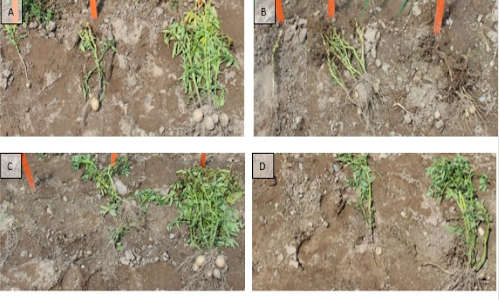
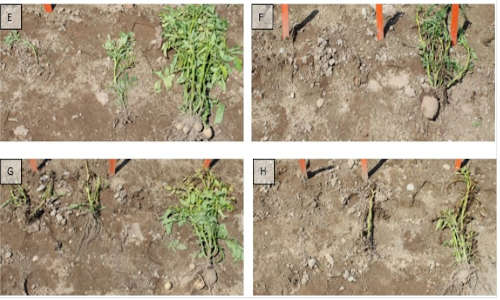
Results in Figures 1-3 highlight two important facts. First, the addition of atrazine to herbicide treatments improved control. Second, as the size of volunteer potatoes increased, control decreased. When applications were made to small volunteers (less than 6 inches), 60% of treatments resulted in one or no daughter tubers produced per plant. When applications were made to medium (6-12 inches) or tall (more than 12 inches), only 25% and 0% of treatments resulted in one or no daughter tubers produced per plant (Fig. 1). A similar trend was observed in mean daughter tuber weight (Fig. 2).
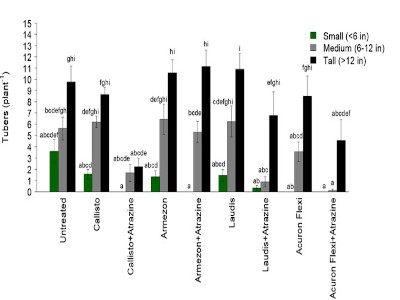
Figure 1. Mean daughter tubers produced per plant at the Montcalm Research Center location. Mean tubers (plant-1) values followed by the same letter are not significantly different (P ≤ 0.05).
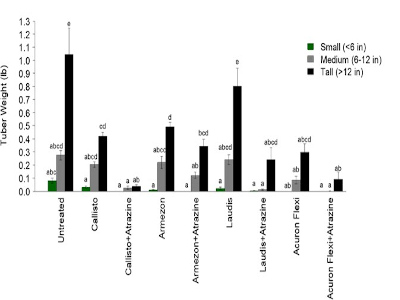
Figure 2. Mean daughter tuber weight at the Montcalm Research Center location. Mean tuber weight values followed by the same letter are not significantly different (P ≤ 0.05).
In addition to the treatments outlined in Table 1, we also tested glyphosate in both years. In 2018, glyphosate provided little control. In contrast, in 2019 glyphosate was highly effective at controlling volunteers. Given this variability, if glyphosate is applied to control volunteers, scout fields two weeks after application to ensure sufficient control.
Finally, keep in mind your plans for future rotational crops and consult Table 12 – Herbicide Crop Rotation Restrictions in the 2020 MSU Weed Control Guide for rotation restrictions.
The Michigan Potato Industry Commission supported this research. For full study details and additional results, see the 2019 Michigan Potato Research Report.
Source : msu.edu