By Adriana Murillo and Paul d Esker
Soybean growers in Pennsylvania must be aware that the soybean cyst nematode (SCN, Heterodera glycines) has been found in Lancaster and York counties. Not really concerned yet? As a reminder, SCN is the pathogen that causes the greatest yield losses in soybean in the United States. The nematode moves from field to field on anything that can move soil and infected roots: tractor tires, run off water, ag implements, humans and animals.
In New York, the number of counties where at least one field has tested positive for SCN has steadily increased in the last 5 years, making Pennsylvania the last soybean-producing state where SCN is not considered widespread. Is this really true though? Soybean cyst nematode could be unknowingly present in more Pennsylvania fields than we think. Remember that SCN can infect plants without causing aboveground symptoms, and by the time farmers start to notice something is wrong with their crop and diseases like Sudden Death Syndrome have become more severe, SCN population levels will be very high and more difficult to manage. Therefore, scouting your fields for SCN benefits you and all soybean growers in Pennsylvania. Early detection of this soybean pest is the best tool to manage the disease and prevent its spread.
How do you scout for SCN?
It is simple. You will need to dig out roots and look for small white, lemon-shaped structures (cysts) attached to the roots (Figure 1). Use a shovel or a hand trowel to dig out plants from different areas in the field and examine their roots. In some cases, dipping the roots in a bucket with water facilitates soil removal.
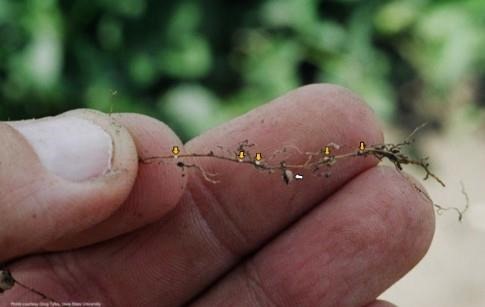
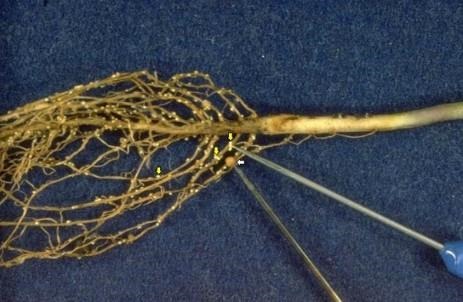
Figure 1. Soybean roots infected with SCN (yellow arrows). Compare the size and the color of the cysts with those of nodules (white arrows).
If you find cysts, you should send soil samples to a Nematology Laboratory to confirm presence and know what the SCN population levels are in your field. Contact your local Agronomy Extension Educator if you want to take advantage of the free SCN testing program being offered through Penn State Extension and the support from the SCN Coalition and the Pennsylvania Soybean Board.
Source : psu.edu