A woman tried to bring giraffe feces back from Kenya
By Diego Flammini
Staff Writer
Farms.com
Customs and Border Protection (CBP) ag specialists recently intercepted a strange package arriving from Africa.
“The passenger declared (the) giraffe feces and stated she had obtained the droppings in Kenya to make a necklace,” CBP said in an Oct. 5 statement about the incident, which occurred on Sept. 29 at the Minneapolis – Saint Pail International Airport. “The passenger also stated in the past she had used moose feces at her home in Iowa.”
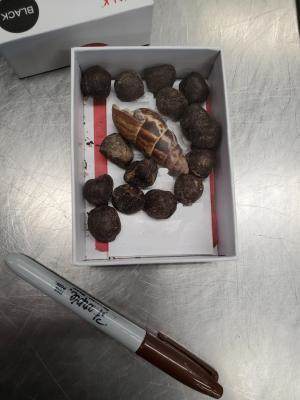
Giraffe feces intercepted in Minnesota (CBP photo).
Bringing feces from ruminant animals into the U.S. is allowed with a Veterinary Services Permit.
The ag inspectors destroyed the droppings using steam sterilization.
Steel pressure vessels called autoclaves are brought to a temperature of at least 250F, “which is effective at inactivating microorganisms and proteinaceous bacterial and plant toxins,” the USDA says.
Kenya is affected with multiple disease that could affect U.S. ag.
This includes African swine fever, classical swine fever, Newcastle disease, foot and mouth disease, and swine vesicular disease.
The CBP commended the traveler for her honesty about the package.
“There is a real danger with bringing fecal matter into the U.S.,” LaFonda D. Sutton-Burke, CBP Director, Field Operations-Chicago Field Office, said in a statement. “If this person had entered the U.S. and had not declared these items, there is high possibility a person could have contracted a disease from this jewelry and developed serious health issues."
A few days prior to the discovery in Minnesota, CBP ag specialists in Oklahoma announced they intercepted potentially dangerous ag goods.
On Oct. 3, CBP revealed it found multiple packages arriving from Asia.
One product was labeled and had paperwork identifying it as jewelry, but further inspection revealed the box contained edible birds’ nests.
“Edible bird’s nests are a centuries-old delicacy. Edible-nest swiftlets, a species of bird native to Southeast Asia, build the nests from their saliva. The nests are used therapeutically in traditional Chinese medicine,” Healthline reported.
Necessary documentation is required to import this kind of product.
But edible birds’ nests are prohibited, the CBP says, “due to highly pathogenic avian influenza and Newcastle disease – a common for the Asia region.”
Another package arrived labeled and documented as cotton t-shirts.
But secondary examination found 20 pounds of raw unshelled peanuts.
Permits and phytosanitary certificates are required to bring raw and unroasted peanuts into the U.S.
CBP destroyed both items with steam sterilization.