What’s going on in Canada? What about in our communities?
By Diego Flammini
Assistant Editor, North American Content
Farms.com
About 40 per cent of food produced in Canada, or about $31 billion worth of food, is wasted, Ralph Martin, a professor from the Ontario Agricultural College’s Department of Plant Agriculture, says.
“And overall on a global scale, about one third of food is wasted,” Martin told a room of observers at AgScape’s annual general meeting at the University of Guelph. “We produce more food than we sell and we sell more food than we consume.”
“One billion people could be fed with the food that’s wasted.”
Martin presented his information during a panel discussion titled Trashing Food Waste. He focused on national and global food waste, and identified six strategies consumers can adopt to reduce it.
“We could spend less money on meat but buy higher quality meat,” he said. “And we could eat more pulses.”
The other five strategies are:
- feeding people with co-products (using food destined for the garbage to make purees),
- using food to feed pets or livestock,
- use it for anaerobic digestion (use the food to break down other biodegradable material),
- using food for biodiesel, and
- diverting food from landfills.
Canadian households spend an average of $155/week on food but throw out $31/week, according to Martin. Organic shoppers spend $27/week more, he said.
“That’s like going shopping and buying five grocery bags and leave one in the parking lot,” he said.
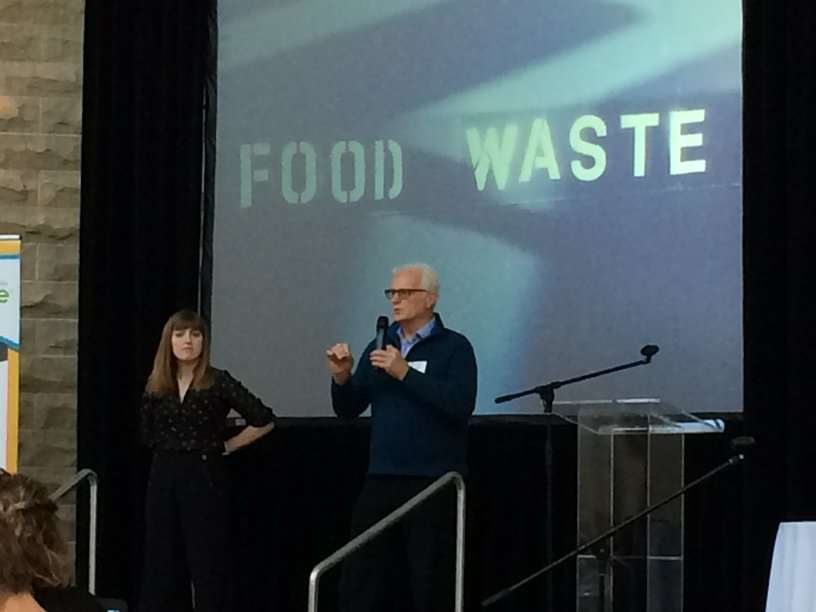
L to R: Mychal-Ann Hayhoe and Ralph Martin.
And while Martin’s presentation focused mainly on Canada, another presentation revolved around the bins at the curbs of Guelph streets.
“We evaluated residential food waste,” said Mychal-Ann Hayhoe, a Ph.D. candidate at the University of Guelph’s School of Hospitality, Food and Tourism Management. “We did audits of the garbage that went out to the curb.”
On average, Guelph homes produce between 3.5 and 4.5 kg of food waste per week, 53 per cent of which was avoidable, she said.
“When we say avoidable, we mean your loaf of bread that’s gone bad. You left it (in the fridge too long), it gets mold on it and gets thrown out.”
Fruits and vegetables were the highest concentration of wasted food.
“(0.3 to 0.4) kg per day (was) wasted,” said Hayhoe. “40 per cent of this was unavoidable (pits, stems, etc). Lots of people are wasting fruits and vegetables.”
Animal products, including meat and eggs, were wasted less – likely because they’re more expensive items, she said.
“You plan your meals better when (the food) is higher priced.”
When it comes to cereal and grains, all of the food waste was avoidable, according to Hayhoe.
“You buy breads or a bag of rice and 100 per cent of that is edible,” she said. “If you throw it out, that’s 100 per cent avoidable waste.”
According to the Toronto Food Policy Council:
- Land filled organic matter creates methane gas which is 25 times more damaging to the environment than carbon dioxide,
- 47 per cent of food waste in Canada happens at home. 53 per cent takes place along the value chain,
- Canadians wasted $183 kg of solid food per person in 2007, according to Stats Canada, and
- About 80 per cent of consumer food waste was once perfectly edible.