Dryer weather conditions across most of the Prairies limited fusarium head blight (FHB) disease in cereal crops in 2017. However, cereals grown in shortened crop rotations will continue to be vulnerable during the current crop season due to more severe FHB incidence in many areas in 2016.
“A one year break away from a host crop is not enough time to permit this serious fungal disease to adequately decompose,” says Neil Whatley, crop specialist at the Alberta Ag-Info Centre. “Infected crop residue from 2016 continues to pose a serious threat to cereals in 2018 if favourable weather conditions occur.”
Cereal crops are most vulnerable to infection at flowering time when the disease spores, dispersed primarily by wind, infect the cereal plant. Disease severity is greater under weather conditions of high humidity and warmer temperatures, 15 to 25 C, in June and July that favour spore development.
“While complete control of FHB is unattainable, producers can suppress the disease in cereal crops by applying a fungicide,” says Whatley. “Although several fungicides are registered to suppress FHB, strobilurin (Group 11) fungicides are not recommended.”
“Observable FHB symptoms don’t appear until the late heading stage when it is too late to apply protective fungicide. Therefore, a decision to apply a fungicide must be made prior to this, at the flowering stage, to protect emerging heads,” adds Whatley.
If disease risk level is assessed as moderate to high and yield return justifies fungicide application cost, a foliar fungicide should be applied at the flowering stage to protect emerging heads. Disease risk level increases when more of the following factors exist:
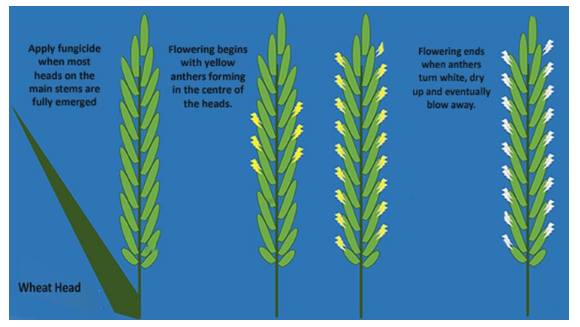
“Under ideal growing conditions, the length of time from when the wheat head is just emerging from the boot to the beginning of flowering is three days, so begin scouting closely when the head begins to emerge from the boot,” says Whatley. “The spray window begins when most of the heads on the main stems are fully emerged from the boot and continues through the time when yellow anthers form on the heads. As mentioned, barley begins to flower in the boot, however, wait until most of the barley heads have emerged from the boot before spraying. Ultimately, good head coverage prior to infection is critical for improving fungicide efficacy for both wheat and barley. Recent research suggests that fungicides continue to provide suitable suppression of FHB when applied 4 to 6 days after the start of flowering, or approximately 7 to 10 days following full head emergence. If considering a later application, follow the pre-harvest interval specified for each fungicide product.”
Dr. Tom Wolf’s (AgriMetrix Research & Training) fungicide spray recommendations for FHB are:
- Angle nozzles forward or use a double nozzle (forward and back).
- Greater angles are better.
- Use coarse sprays.
- Maintain low boom height.
- Fast travel speeds are fine for vertical targets (cereal heads).
- Water: recommend 15+ gallons per acre (70+ litres per acre).
- Field is located in a region where FHB is established.
- Cereal variety being grown is susceptible to FHB.
- Durum or corn is in the crop rotation or in adjacent fields.
- Cereal crops are frequently grown in the same field or in nearby fields.
- Weather conditions are damp and warm at crop flowering stage.
- Irrigation is used in the farm operation.
- Yield potential is good.
- Cereal grain prices are high.
Alberta Agriculture and Forestry’s Alberta Climate Information Service (ACIS) has developed the weather-based FHB risk forecast webpage to assist growers with making a spraying decision and for more accurate timing of a fungicide application. This forecasting tool provides local and hourly FHB risk levels using near-real-time weather data that growers can correspond with the correct heading stage for appropriate fungicide application timing. Mobile friendly www.weatherdata.ca/m also features the FHB webpage and can be added to a smart phone’s home screen.
The period of time that a cereal plant is susceptible to infection is short. Therefore, the spray window is also short, approximately seven days. Warmer weather conditions narrow the spray window while cooler conditions widen the spray window. FHB fungal spores infect the cereal plant by entering openings created where tiny flowers - referred to as anthers - form on the cereal head. Wheat flowers after the head is fully emerged from the boot while barley begins flowering as the head emerges from the boot. Tiny yellow anthers initially form in the middle of a head, ultimately developing over the full length of the head, and finally turning from yellow to white as they age and dry out before blowing away.
Source : Alberta Ag and Forestry