By Chuck Burr and Daran Rudnick
In years when late harvest limits winter wheat establishment or when winter injury reduces stand, spring hard red wheat might be a viable option. This study looked at water consumption (evapotranspiration), productivity and protein content of hard red spring wheat at the Henry J. Stumpf International Wheat Center near Grant, Nebraska in 2021.
Hybrid Westbred 9590 was planted on March 15 at a seeding rate of 1.6 million seeds per acre on a one-acre plot on a Kuma Silt Loam Soil with 0-1% slope. Full establishment was delayed until April 23 due to dry conditions. The spring wheat was uniformly managed. Nitrogen (N) in the form of dry urea (46-0-0) was broadcast at a rate of 150 lbs. per acre on May 3. The spring wheat was irrigated using Valley Center Pivot with variable rate technology and using Senninger iWob UP3 sprinklers on 10-foot spacing. Harvest occurred on July 21 using a John Deere 9500 combine with a Shelbourne Stripper header.
A neutron moisture meter, NMM, (Campbell Pacific Nuclear, Concord, California) was used to measure soil water content at three locations in the field. Measurements were taken every six inches to a depth of 54 inches approximately every 14 days starting May 4 and concluding July 16. Soil water measurements were used to approximate spring wheat evapotranspiration using a simplified soil water balance:
ET = R + I – RO – DP ± ?S
where, R is rainfall, I is irrigation, RO is runoff, DP is deep percolation below the rootzone, and ΔS is change in soil water storage. Rainfall was measured from an automated weather station located at the Stumpf Center and data was downloaded from the High Plains Regional Climate Center (HPRCC). Change in soil water storage was measured using the NMM. Runoff and deep percolation were considered negligible since the field had little slope, hourly rainfall rates were not excessive and soil water measurements at the lower depths did not exceed field capacity.
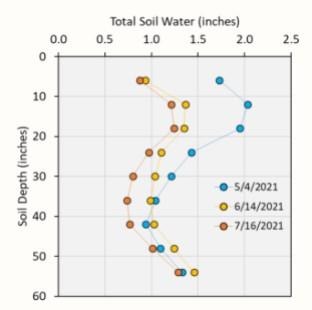
Figure 1. Total soil water (inches) every six inches to a depth of 54 inches measured using a neutron moisture meter under an irrigated hard red spring wheat production field located at the Henry J. Stumpf International Wheat Center.
The average daily minimum and maximum temperatures (44.9 oF, 74.1 oF) for March 1 through July 31 for the Grant location were similar to 30-year normal temperatures (Arguez, A. 2012) for Imperial, Nebraska minimum and maximum temperatures (42.6 oF, 73.6 oF).
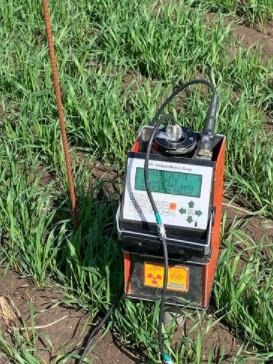
Figure 2. Neutron moisture meter used to measure soil water content in hard red spring wheat.
Rainfall for the Grant location for the same time period was 10.5 inches — about two inches lower compared to the 30-year average at Imperial of 12.6 inches. Rainfall during the soil moisture monitoring period from May 4 through July 16 was 6.95 inches. During this time, the soil water balance declined by 3.86 inches and 3.25 inches of irrigation water was applied.
Using the ET equation from above, total crop water use (i.e., evapotranspiration) was 14.1 inches. This is below reported values of 18 to 21 inches for Montana (Bauder), 22 inches for Scottsbluff, Nebraska (Yonts et. al., 2009), and 20 to 21 inches for Idaho (Ashley et. al., 2001). However, our study did not include the moisture needed to establish a crop since we waited until April 23 to install the NMM access tubes until the wheat was well established.
An effective maximum rooting depth of 3 to 3.5 feet was reported by Ashely et al. (2001). Figure 1 from our study shows that most of the water extracted from the May 4 to July 16 sampling dates shows the greatest extraction in the top 42 inches, indicating an effective rooting depth of 3.5 feet.
The non-replicated plot yielded 65 bushels per acre at a moisture content of 12.4%. The test weight was 60.9 pounds per bushel and the protein content was 14.5%. The yield is slightly higher than the Calculated Yield Equation from (Bauder, J.). Estimated Yield = 5.8(SM + R/I – 4.1) where SM is soil moisture, R/I is Rainfall and Irrigation resulting in an expected yield of 58 bushels. The North Dakota Wheat Commission has an expected protein content for hard red spring wheat at 13-16%.
Source : unl.edu