By Meaghan Anderson
With a warm-up in the forecast, spring fieldwork like cover crop termination will begin when fields are fit. While some farmers may opt to use mechanical methods of cover crop termination like tillage or roller-crimping, chemical termination is the most common and often most effective way to kill a cover crop in preparation for the following cash crop. With the high cost and tight supply of inputs, we’ve compiled some tips to make cover crop termination is effective.
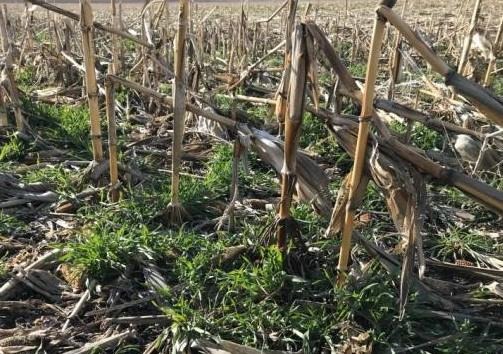 Cover crops have been slow to green up and take off this spring. Photo courtesy of Meaghan Anderson.
Glyphosate is the most consistent product
Glyphosate is the most consistent product in the cool and often fluctuating spring temperatures. Because of this, if a farmer has limited availability of glyphosate the burndown applications should be prioritized. If cereal rye or other grass species are seeded with a legume, inclusion of 2,4-D or dicamba with glyphosate will improve consistency of control of the broadleaf. This addition can also be helpful when broadleaf winter annuals are present.
Choose an appropriate glyphosate rate for the size and condition of the cover crop. In the past, we’ve always recommended using a 1 lb acid equivalent (a.e.) rate, but this is a generous rate to account for spring weather, variation in cover crop size, and the addition of tank mix partners. A rate of 0.75 lb a.e. should be sufficient to kill a small (<18”) cereal rye cover crop if applications are made during favorable growing conditions and best management practices are followed (appropriate additives, good coverage, etc.). Consider these BMPs:
- Pre-treat water with ammonium sulfate (AMS) to reduce hard water issues
- Choose nozzles and carrier volume to prioritize coverage
- Follow label directions for adjuvants and tank mix partners
- Use caution with 'hot' mixes that may burn leaf tissue and reduce translocation of glyphosate
- Spray in the middle of a sunny, warm (>60F) day with a 3-5 day forecast that doesn’t get below 40F if possible
If you’re using a new glyphosate product or adjusting the rate from prior years, use the “Glyphosate math” blog to determine the equivalent rate of the new glyphosate product.
Glyphosate alternatives
If a farmer is unable to secure glyphosate this spring, paraquat or some group 1 herbicides are possible alternatives, although research continues to show they provide less consistent control than glyphosate. These products are more likely to be effective when weather conditions are favorable. The addition of metribuzin or atrazine to paraquat will improve consistency. Both paraquat and group 1 products list volunteer cereal grasses on the labels for burndown and applications are most effective on cereals less than 6 inches tall. Some farmers in Iowa have also noted that paraquat can hasten rye maturity when applications are made to headed-out plants prior to planting soybean. In general, researchers have noted mixed success with the group 1 products. Applications to large cereal grasses often result in a slower death than with glyphosate, and cereal rye remaining more upright than when terminated with glyphosate. Check out this cover crop termination article to see some data related to glyphosate and alternatives for control.
Final thoughts
Other researchers have done an excellent job in discussing specific considerations for termination in individual crops and for those with multi-species mixes. In particular, Bill Johnson, Marcelo Zimmer, and Bryan Young with Purdue University wrote an article last fall on planning for termination of multispecies cover crop mixtures that may be useful.
Always look at the herbicide labels for directions and any restrictions for the subsequent crop. A quick and easy place to look up herbicide labels is www.cdms.net or www.greenbook.net.
Source : iastate.edu