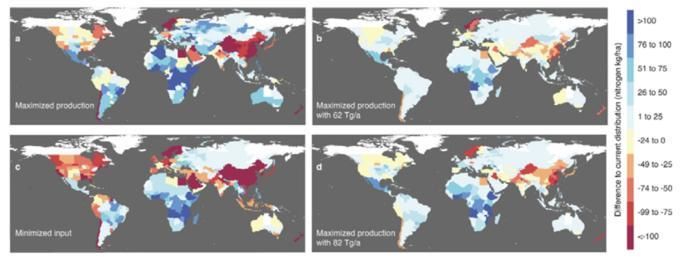
Shifting some use of nitrogen from rich countries to poor countries would improve food security and environmental sustainability, according to a study. Wealthy countries tend to use too much nitrogen fertilizer, which leads to climate change, water pollution, and biodiversity degradation.
Poor countries lack sufficient nitrogen to attain proper crop yields. Helena Kahiluoto and colleagues quantified the optimal redistribution of nitrogen input for production of maize, rice, and wheat among countries and sub-national regions, using a set of nitrogen-yield response functions from an ensemble of empirically evaluated global gridded crop models.
The authors modeled production for both the current level of nitrogen use and for lower levels deemed sustainable. In addition, the authors modeled the lowest possible use of nitrogen to achieve today’s level of food production. Optimal redistribution of today’s level of nitrogen use would increase global crop production by 12%.
In this scenario, countries with moderate or severe food insecurity in more than half of the population would see eightfold increases in nitrogen use and 108–110% increases in food production. In eastern Asia, maximization of global production would reduce nitrogen input by half while production would decline only by 6%, with most of this decline occurring in China.
The authors found that current levels of global maize, rice, and wheat production could be maintained with just 53–68% of the current nitrogen used, if the nutrient were redistributed.
Click here to see more...