By Erin Hodgson
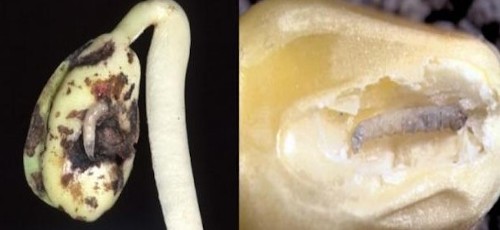
Seedcorn maggot is a seed and seedling pest of corn and soybean. Plant injury is especially prevalent during cool and wet springs. The larvae, or maggots, feed on germinating corn and soybean seeds or seedlings (Photo 1). Feeding can delay development or kill the plant. Infestations tend to be field-wide instead of in patches like for many other pests. To confirm seedcorn maggot injury, check field areas with stand loss and look for maggots, pupae and damaged seeds (hollowed out seeds or poorly developing seedlings).
Biology
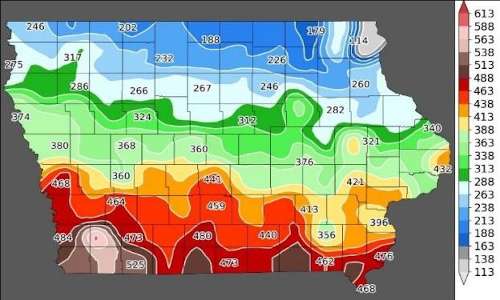
Seedcorn maggots overwinter in Iowa as pupae in the soil. Adult flies emerge and mate in April and May, then females lay eggs in soil. Maggot densities are higher in soils with high organic matter. Land that is heavily manured may be especially attractive to early-laying females. Recent soil tillage, regardless of residue type, is attractive to egg-laying females. This fly species has a lower developmental threshold of 39°F and upper threshold of 84°F. Peak adult emergence for the first generation is at 360 accumulated degree days. Based on current accumulated degree days, expect the first generation to be moving around in southern and central Iowa now. There are 4-5 generations of seedcorn maggot per year in our area. Recent freezing temperatures may temporarily slow the development in all areas.
Identification
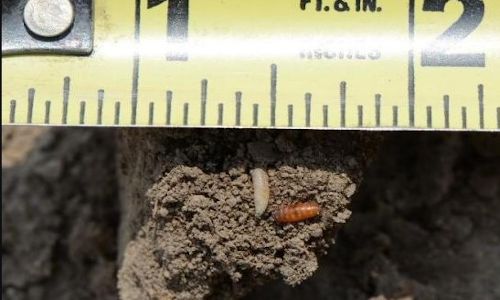
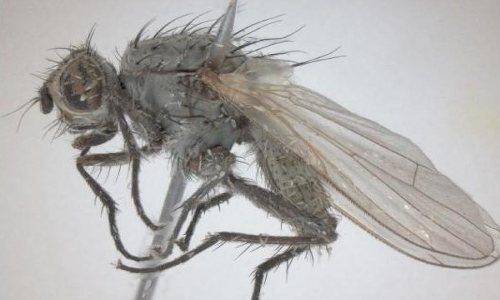
Seedcorn maggots are white, legless and 1/4 inches long with a tapered body (Photo 1). The maggots have a black mouth with hook-like mouthparts to feed. The pupa is brown and looks like a “wheat seed” (Photo 2). The adult fly is grey to brown in color with red eyes. Adult seedcorn maggots are 1/20th inches long and look like a small house fly (Photo 3).
Management
There are no rescue treatments for seedcorn maggot. No-till fields are less attractive to egg-laying females. Target planting when soil and moisture conditions are conducive to quick germination and vigorous growth to reduce seed and seedling pest problems. Farmers with persistent seedcorn maggot infestations should consider a later planting date, shallower planting, higher seeding rates, and earlier termination of cover crops (Bessin 2004). Waiting two weeks (or 450 growing degree days) after tillage or manure applications to plant corn or soybean should provide enough time for the seedcorn maggots to complete development and move to another host (Gessell and Calvin 2000).
Insecticidal seed treatments are also an option for persistent seedcorn maggot pressure. If significant stand loss occurs, replanting the field is an option. A replant decision should be based on percent stand loss and cost of additional seed. Corn and soybean resources to aid in replant decisions are available at https://store.extension.iastate.edu/Product/Soybean-Replant-Decisions.
Source : iastate.edu