Deb Stark speaks at Advancing Women Conference
By Diego Flammini
Assistant Editor, North American Content
Farms.com
The first guest speaker to kick off the Advancing Women in Agriculture Conference at Toronto’s Fairmont Royal York hotel on Monday morning was Deputy Minister of Agriculture, Food and Rural Affairs, Deb Stark.
Deputy Minister Stark’s presentation focused on what the role of women in agriculture could be.
And her response was direct.
“You can do whatever you want,” she told a room full of women. “There are some barriers, but there are women doing anything and everything in food and agriculture today.”
Stark said she used various channels to reach out to women in agriculture to find out what some of Canada’s farm women felt were important concerns.
“Some of the points you made exactly match what I hear from some of the ag organizations,” she said. “The importance of foundational research and how important risk management systems are.”
Stark said of all the responses, the most consistent theme was a plea for inclusion; and she provided a few suggestions.
“Be inclusive. Don’t just talk about it. And the other is to own your boldness,” said Stark.
Stark said the industry needs to recognize the need for more women in leadership roles.
According to a study by the Canadian Agriculture Human Resources Council, 12 per cent of men surveyed believed there were barriers to women advancing in agriculture.
About 40 per cent of women felt there are barriers.
“We have a long way to go,” Stark said.
Her other suggestions included looking for systemic barriers, which include technology or if a building can’t accommodate wheelchairs or strollers.
She also suggested to look inward at personal thinking patterns.
“We’re all biased,” she said. “How many times have you gone to the doctor and seen a man and woman in their uniforms and assume the man is the doctor and the female is the assistant?”
When it comes to women owning their boldness, Stark said sometimes it means standing up for those who aren’t as bold, or asking a colleague of the opposite sex to act as a mentor.
To summarize her presentation, Stark quoted Dr. Seuss: plea for inclusion; and she provided a few suggestions.
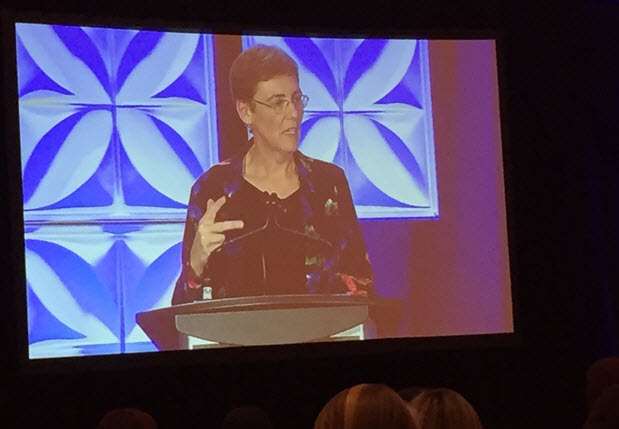
Deb Stark addresses the audience at the Advancing Women in Agriculture Conference.
Photo: Andrea Gal/Twitter
“Be inclusive. Don’t just talk about it. And the other is to own your boldness,” said Stark.
Stark said the industry needs to recognize the need for more women in leadership roles.
According to a study by the Canadian Agriculture Human Resources Council, 12 per cent of men surveyed believed there were barriers to women advancing in agriculture.
About 40 per cent of women felt there are barriers.
“We have a long way to go,” Stark said.
Her other suggestions included looking for systemic barriers, which include technology or if a building can’t accommodate wheelchairs or strollers.
She also suggested to look inward at personal thinking patterns.
“We’re all biased,” she said. “How many times have you gone to the doctor and seen a man and woman in their uniforms and assume the man is the doctor and the female is the assistant?”
When it comes to women owning their boldness, Stark said sometimes it means standing up for those who aren’t as bold, or asking a colleague of the opposite sex to act as a mentor.
She spoke about how once a problem is recognized, there's a need to address it.
Stark used a quote from a Dr. Seuss book to highlight how it can be done.
“You have brains in your head. You have feet in your shoes. You can steer yourself any direction you choose. You're on your own. And you know what you know. And YOU are the one who'll decide where to go...”
Use the hashtag #AWCeast2016 to follow the conference on social media.