By Autumn Lankford Higgins and Bernt Nelson
Key Takeaways
- Farmland conversion is generally permanent, making site selection and land-use policy critical for long-term agricultural viability.
- Data centers create both economic opportunities and resource pressures, particularly around land, water and energy.
- Data centers represent multi-billion-dollar investments that can bring jobs, tax revenue and infrastructure improvements to rural communities.
- Balanced policy and local engagement are essential to ensure rural communities benefit without undermining agriculture.
Overview
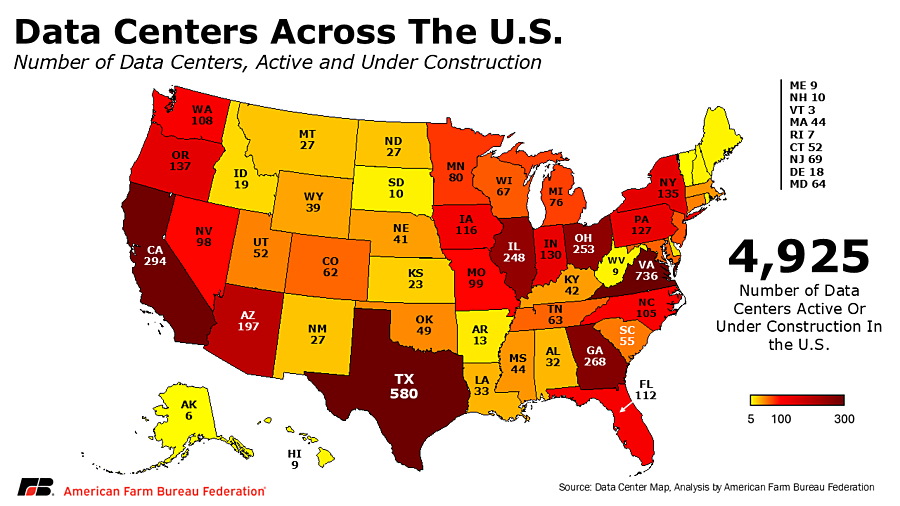
Demand for data centers – large, secure facilities that house computers and servers used to store, process and manage vast amounts of digital data – is accelerating as cloud computing, artificial intelligence and other digital services expand across the United States. These facilities form the backbone of the modern economy, powering the internet and enabling the applications and services relied upon by businesses, governments and everyday consumers. According to Data Center Map and analysis by AFBF, it is estimated, that there are 4,925 active or under construction data centers across the U.S. These facilities, often requiring hundreds of megawatts of power are increasingly sited in rural areas where land availability, energy access and proximity to transmission infrastructure make development feasible.
The scale of investment is significant. Construction costs range from $9 million–$15 million per megawatt, meaning a typical 250-megawatt facility can cost between $2.3 billion and $3.8 billion, while the price tag for larger campuses can reach tens of billions of dollars. These projects are not just industrial developments; they are long-term infrastructure commitments that shape local economies for decades.
Click here to see more...