By Shep Eubanks
Bermudagrass Stem Maggots continue to be a cause of consternation to producers of high quality hay in the Panhandle in 2016. Research in Georgia indicates that, since their first discovery in that state in 2010, stem maggots have spread across the southeast. In Georgia the documented incidence of Bermudagrass Stem Maggot (BSM) has increased each year since. In 2015, some fields in Georgia reported 80% yield losses. In Gadsden County, it has been my observation that this is another year of increasing pressure from this pest.
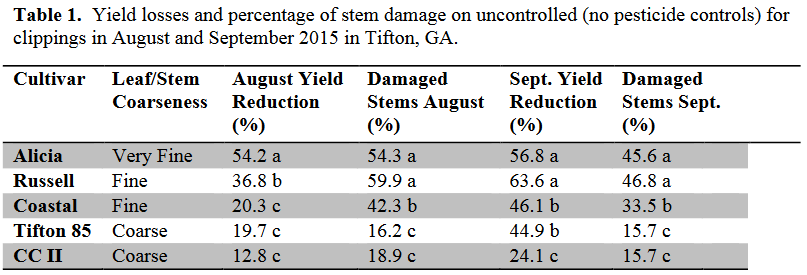
Dr. Dennis Hancock at the University of Georgia conducted some interesting trials in Tifton, Georgia in 2015 (Table 1) that highlighted the potential yield losses from BSM in both fine and coarse stemmed varieties of bermudagrass. In their trial they compared yields and stem damage of plots that received control measures as opposed to plots with no control. Yield loses were high in the fine stemmed varieties, but significant yield losses occurred in the coarse stemmed varieties like Tifton 85 as well. Yield losses were also higher in September versus August in this study.
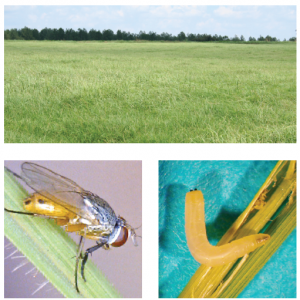
Stem maggots are a relatively new pest of Bermudagrass hayfields in the Southeast.
We still do not have a sure fire way to control the stem maggot and there is a lot of research to be done to quantify a more precise protocol. Damaged fields that are close to harvest (within 2 weeks) should be hayed or grazed. For now, in fields where producers have experienced previous losses, scouting for the adult flies and spraying when they are observed with two sprays of the lowest labelled rate of a pyrethroid for suppression is the best solution. Infested fields should receive the first application 7-10 days after harvest, followed by the second application 7-10 days after that.
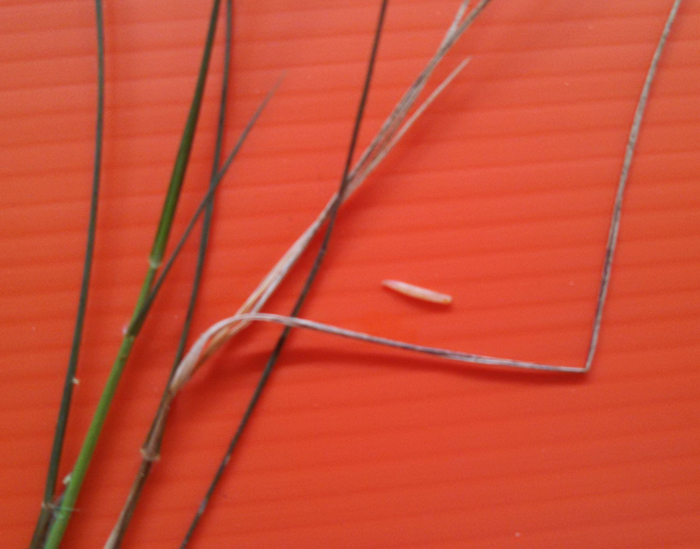
Bermudagrass Stem Maggot identified in Holmes County Bermudagrass hay field. Photo Credit: Liza Garcia-Jimenez
Source:ufl.edu