A team of Clemson University researchers has found soybean crop performance improved after planting cover crops during the fall-winter season in South Carolina’s clayey soils.
Ricardo St. Aime and Sruthi Narayanan, Clemson researchers in the Plant and Environmental Sciences Department, and William Bridges from the Clemson School of Mathematical and Statistical Sciences, planted cover crops of grasses, legumes and brassicas on fields located at the Clemson Piedmont Research and Education Center’s Simpson Research Farm in Pendleton, South Carolina. The aim was to evaluate winter cover crops for biomass production, as well as determine the effects of cover crops on weed presence, stored soil water and soil health, as well as the performance of soybeans later planted on the fields.
“This study was conducted after South Carolina farmers indicated they wanted more information about the effectiveness of cover crops,” St. Aime said. “We evaluated the short-term benefits cover crops to produce information that farmers could use to choose cover crop species.”
Cover crops tested as both single species and mixtures included rye, oat, wheat, crimson clover, hairy vetch, Austrian winter pea, turnip and radish. Field studies were conducted in the 2019-2020 season and, again, during the 2020-2021 season.
Before the study began, soil samples were tested at the Clemson University Agricultural Services Laboratory. During the first season, field preparation included chisel plowing and harrowing with a field cultivator. No plowing was done in the second season. No irrigation was used, and the plots were maintained under rainfed conditions during both seasons. Based on precipitation data, the first season was wetter than normal. Season 2 was drier than normal during the cover crop growing season, but received normal precipitation amounts during the soybean growing season.
Musen was the soybean cultivar planted.
The researchers found the cover crops that produced the greatest amounts of biomass during both seasons were either the single species of rye or the mixtures containing rye. They also found weeds were better suppressed, soil penetration resistance was reduced (roots were able to develop and grow) and subsequent soybean yields were maintained or improved.
“Our results demonstrate the advantage of using fall-winter cover crops over keeping land under a chemical fallow,” Narayanan said.
Weed suppression is one of the most sought-after short-term benefits of cover crops. Rye is one of the highest biomass-producing cover crops grown in the southeastern region. The researchers found two grass-legume cover crop mixtures, a mixture of rye and crimson clover, and a mixture of Austrian winter pea, rye, crimson clover, hairy vetch and oat (five-a) produced the same amount of biomass as rye.
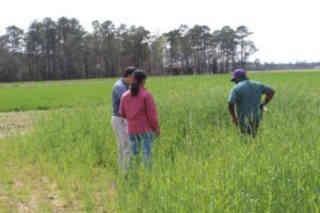
The researchers also found the high-biomass producing cover crops did not deplete more soil water than did the field where chemicals were used to control weeds. These cover crops also controlled weeds equally well or better during the cover crop growing period. The mixture of five-a, which is a combination of two grasses and three legumes, also improved soil biological activity.
“Overall, our results suggest rye, the mixture of the five-a and the mixture of rye and crimson clover are suitable winter cover crops for the clayey soils in the southeastern United States based on biomass production, weed suppression and improvements in soil health and the following soybean crop performance,” Narayanan said.
Source : clemson.edu