Farms.com Home   News

Dairy’s 2020 Gains Were Steady In A Year That Was Anything But

We’ll spare you the long story of how 2020 was difficult for everyone – assuming you aren’t a time-traveler or a visitor from outer space, you already know it. And if you follow this column, you’ll know that consumers turned to dairy in difficult times, from baking at home to stocking up on fluid milk in the COVID-19 pandemic’s earliest days.
map

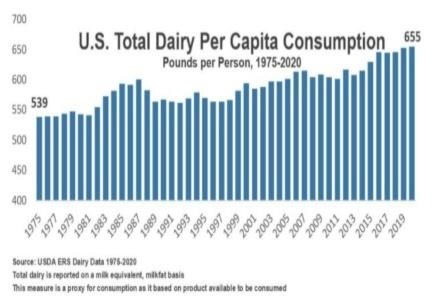
But the final consumption data for 2020 is now in, and the spreadsheet confirms what we already knew in our hearts: For the third consecutive year, U.S. per-capita dairy consumption increased, to 655 pounds per person from 653 pounds in 2019, showing a resilience in dairy that reflects that of those who relied on it.

No eye-poppers in this year’s report. A small uptick in yogurt, a gain in butter as it marches back to 1960’s-level consumption, increased buying of both full-fat and lower-fat ice cream – because what’s a ­­­lockdown without ice cream? And fluid milk consumption held steady, belying the haters who always use receding prominence  as fake evidence of the “death of dairy” even as gains among other dairy products more than outpace any fluid losses.

Click here to see more...

Trending Video

Sweetener Effects on Gut Health - Dr. Kwangwook Kim

Video: Sweetener Effects on Gut Health - Dr. Kwangwook Kim


In this episode of The Swine Nutrition Blackbelt Podcast, Dr. Kwangwook Kim, Assistant Professor at Michigan State University, discusses the use of non-nutritive sweeteners in nursery pig diets. He explains how sucralose and neotame influence feed intake, gut health, metabolism, and the frequency of diarrhea compared to antibiotics. The conversation highlights mechanisms beyond palatability, including hormone signaling and nutrient transport. Listen now on all major platforms!

“Receptors responsible for sweet taste are present not only in the mouth but also along the intestinal tract.”

Meet the guest: Dr. Kwangwook Kim / kwangwook-kim is an Assistant Professor at Michigan State University, specializing in swine nutrition and feed additives under disease challenge models. He earned his M.S. and Ph.D. in Animal Sciences from the University of California, Davis, where he focused on intestinal health and metabolic responses in pigs. His research evaluates alternatives to antibiotics, targeting gut health and performance in nursery pigs.