Frogeye leaf spot (FLS) is a common foliar disease in North Carolina soybeans especially in our Northeastern and Piedmont counties. Frogeye leaf spot is a fungus caused by the pathogen Cercospora sojina. It can infect soybean plants at any stage of development, but disease most often occurs after flowering. The disease is most serious during periods of warm, humid weather which means the weather patterns over the last few weeks make for ideal frogeye leaf spot conditions. As beans begin to enter reproductive growth, scouting for FLS will be important.
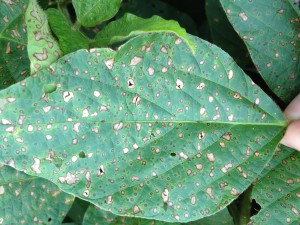
Symptoms of FLS include small, circular to angular spots on the leaves that eventually enlarge to about ¼ inch in diameter. These spots will have light brown to translucent centers which are surrounded by reddish brown margins. Young leaves are typically more susceptible to the fungus than older leaves therefore in fields with intermittent wet periods, symptoms may appear layered within in canopy.
The most effective way to combat FLS is by planting resistant varieties. Obviously, changing the variety at this point in the season is not an option, but what you can do is take note of fields where there are FLS problems this season and select varieties resistant to FLS for these fields in future. A list of varieties with at least moderate resistance to FLS is produced each year by Dr. Jim Dunphy and can be found here. In addition, fields with FLS problems should not be planted with soybean for at least one and preferably two years after the disease was identified, as the fungus survives in crop residue. Fungicide seed treatments may also help prevent FLS.
Click here to see more...