By Jose Dubeux
Grazing management is a mix of art and science. The “art” comes from the action of managing livestock in a given landscape, and learning based on experience. The “science” comes from experimentation with scientific protocols used to validate a hypothesis. The best of both worlds is to combine the science and the art. There are three major components of grazing management that affect forage and livestock responses: 1. defoliation frequency, 2. defoliation intensity, and 3. timing of defoliation. These three components interact and affect production and quality responses. The combination of frequent and intense defoliation, for example, leads to overgrazing, which typically negatively affects multiple components of the grassland ecosystem including vegetation, soil, and the grazing animals. Selecting the right combination of forage species is also key to obtain maximum benefit. Multiple forage species mixtures have the advantage of maximizing growth, especially if the right combination of species are present. Combining early with late-maturing varieties extends the growing season. Clovers, for example, might help to extend the grazing season during the spring, especially if you have a blend of early (e.g. Crimson clover) and late (e.g. ball clover, red clover) varieties (Figure 1).
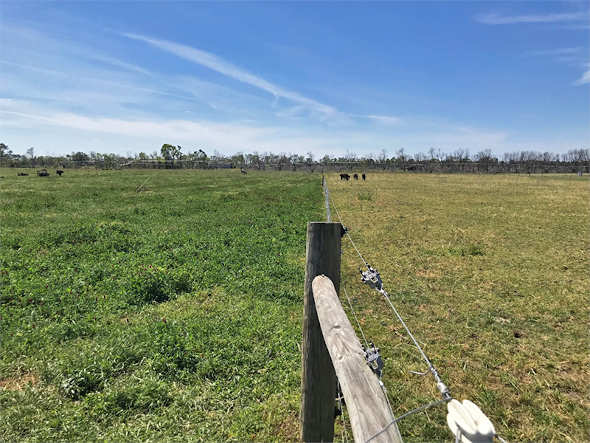
Figure 1. Cool season grass (oat and rye) mixed with crimson, red, and ball clover on the left and just grass (oat and rye) without clovers on the right. Photo credit: Jose Dubeux
Stocking rate, average daily gain, and gain per area: how are they linked?
Stocking rate, and ultimately grazing pressure, is the overriding factor affecting forage and animal responses to grazing conditions. These relationships were established long-ago by a prominent forage researcher, Dr. Gerald Mott. Briefly, if the grazing pressure is low, the individual animal gain is high, because of greater selectivity and forage quality, but the gain per area is low because forage utilization is low. Increasing stocking rate and grazing pressure will increase gain per area up to a point, but because average daily gain starts to decrease, the gain per area will decrease as well at very high stocking rates (Figure 2). These relationships are key to understand grazing management.
Figure 2. Relationship between stocking rate, average daily gain, and gain per area for grazing livestock.
Stocking Method
Stocking method is a defined procedure or technique to manipulate the density of animals in space and time to achieve a specific objective (Allen et al., 2011). There are numerous techniques available, but perhaps the most commonly discussed in grassland literature are continuous vs. rotational stocking. There are variations of rotational stocking, with different resting periods and intensity based on how frequently the livestock is managed. The major goal of the rotational stocking is to allow time for the forage to recover after defoliation occurs. It is important to let the forage reach the steeper growth curve, resulting in greater herbage accumulation (yield) (Figure 3).
Figure 3. Forage growth of Pensacola bahiagrass under continuous or rotational stocking (21-day resting period). Rotational stocking average for 1, 3, 7, and 21 days grazing period. Adapted from Stewart et al. (2005).
It is important to mention that under continuous stocking there is a natural interval between defoliation events. The frequency that the grazing animal returns to the same patch varies with the grazing pressure. Rotational stocking might also enhance spatial distribution of excreta (urine/manure). Rotational stocking with short grazing periods and a high stocking rate results in improved distribution of excreta (Figure 4).
Figure 4. Spatial manure distribution on Pensacola bahiagrass rotationally stocked (1 or 7-day grazing period) or continuously stocked (Dubeux et al., 2014).
Livestock preference for a species in a mixed grass-legume system might lead to overgrazing of the preferred species, especially if the species are spatially separated. This is the case for strip-planted perennial peanut, where cattle prefer the perennial peanut compared with the grass (Figure 5). Stocking methods that allow greater stocking density with a period to recover would likely be a way to keep the balance in the botanical composition.
Figure 5. Livestock grazing on strip-planted perennial peanut. Picture highlights the livestock preference for perennial peanut. Photo credit: Jose Dubeux.
Take-Home Message
Grazing management is key to optimize the process of transforming forages into livestock gain. Stocking decisions affect vegetation, soil, and livestock responses. Managing grazing livestock is a combination of the previous experience of the manager (art) with scientific recommendations based on experimental results (science). Only the combination of those will maximize the end results, which will vary from farm to farm, depending on local conditions.
Source : ufl.edu