By Don Shurley
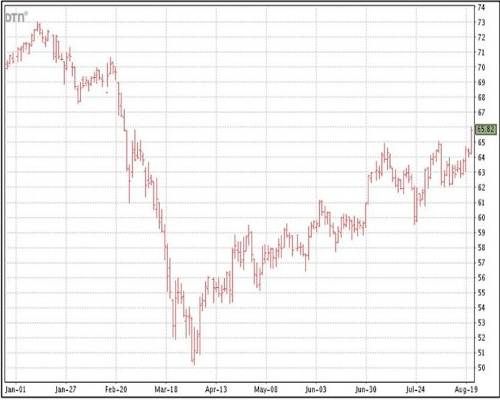
December 20 futures knocked on the door of 66 cents (closed at 65.82 cents per lb) on Monday—the highest daily close in 6 months. December futures gained 1.43 cents last week on weather concerns and a good export report, and gained another 1.54 cents.
Monday’s crop progress report shows the crop slipping a bit with 25% rated poor to very poor compared to 22% last week. The Texas crop is rated 37% poor to very poor compared to 33% last week. Texas is also, however, rated 29% good to excellent compared to 27% last week.
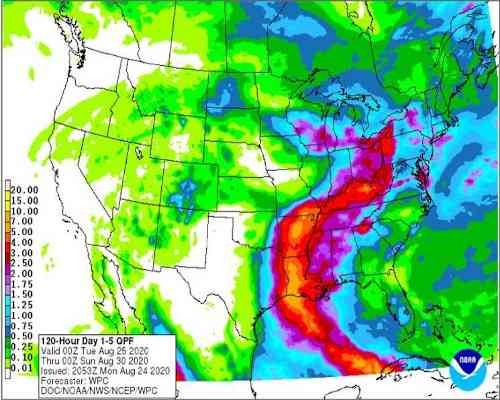
The market is watching 2 Gulf storms—both Marco and Laura and part of the reason for today’s price increase. Marco has now been downgraded to a tropical storm but is expected to make landfall tonight. Later this week, the bigger concern is Laura—expected to make landfall late Wednesday or Thursday as a category 2 hurricane.
Both storms are expected to produce heavy rainfall—not something the cotton crop necessarily needs right now. Rainfall is projected to be 3 to 5 inches or more in some areas of the Mid-South.
August tropical storms and hurricanes can be a mixed bag—having both good and bad impacts on yield and fiber quality depending on prior condition and the development stage of the crop.
On average, the Texas crop is 27% open bolls as of August 23rd. Mississippi is 17% open, Louisiana 40%, Arkansas 25%. Tennessee and Missouri are behind normal and report little to no open bolls as of the August 23rd.
The crop is currently projected at 18.1 million bales. These storms are a double whammy and throw more uncertainty into the mix. Not to downplay potential damage, but on average and in most locations, the crop is reported to be not too far along and yet to be defoliated. Yield and quality damage are likely but could be less than if these storms were to come along a month from now. Flooding may impact the crop in some areas. More tropical storms or hurricanes are certainly a possibility. As we progress toward harvest, the crop will continue a big unknown and the market react accordingly.
Last week’s export report was strong and another reason for the improvement in prices. For the week ending August 13th, export sales were 149,000 bales with 61,180 of that to China. Shipments were a big 442,900 bales with 200,100 bales to China, 84,560 bales to Vietnam, and 46,350 bales to Turkey.
There is little doubt now that 65 to 68 cents could be a reasonable pricing opportunity. This present rally beyond 65 is due to a good export report which reduces fears over the US-China trade situation and to what could be but unknown damage from this week’s storms. Producers must decide “Do I take advantage of 65 to 66 cents on a portion of the crop, or do I wait and take the risk of any further upside (to 68)?”
Source : ufl.edu