By Dallas Peterson
Tansy mustard and flixweed
Tansy mustard and flixweed are two similar mustard species common in central and western Kansas. These weeds emerge in the fall and grow as a rosette with finely lobed compound leaves. Tansy mustard and flixweed bolt in the spring. Small, orange seeds are produced in long, narrow seed pods. Seed pods of tansy mustard are usually about 1/2-inch-long and thicker than flixweed seed pods, which are generally 1 to 1 1/2 inches long.
Tansy mustard (Descurania pinnata) is a native winter annual. The plant is covered with fine hairs. The stem is erect, branched and 4 - 30" high. The flowers are small, pale yellow, and occur in small clusters. Tansy mustard spreads by seed from early to late summer.
Figure 1. Tansy mustard.
Flixweed (Descurainlia sophia) is very similar to tansy mustard, and often confused with it. It is an introduced annual or winter annual species from Eurasia which reproduces by seed. Stems are erect, branched, and 4 - 40" high. Flixweed often grows taller than wheat, while tansy mustard generally does not. Leaves have a lacy appearance. The stem and leaves are covered with fine hairs. Flowers are small, pale yellow, and grow in small clusters. Although tansy mustard is native to the area and flixweed is introduced, flixweed is probably the more common weed problem in wheat fields.
Figure 2. Mature flixweed (top photo); rosette stage (bottom photo).
Bushy wallflower (treacle mustard)
Bushy wallflower, or treacle mustard, (Erysimum repandum) is a common weed in central and eastern Kansas. It is native to Eurasia. It usually emerges in the fall and forms rosettes with long narrow leaves and irregular leaf margins. Most vegetative growth occurs during the spring. Bushy wallflower rosettes bolt in the spring and bear bright yellow flowers at the top of the plant, which only grows to about 12 – 18" tall. Seeds are produced in long, narrow seed pods.
Figure 3. Bushy wallflower or treacle mustard (top photo); rosette stage (bottom photo).
Field pennycress
Field pennycress (Thlaspi arvense) is native to Eurasia. The seedling develops as a compact, vegetative rosette. If it emerges in the fall, it overwinters either as seedlings or vegetative rosettes. It can also emerge from seed in the spring. It bolts in the spring and bears white flowers at the top of the plant, which may grow from 1 to 2 feet tall. Field pennycress has a flat, broadly winged seed capsule that looks something like a penny. Field pennycress reproduces solely by seed. It is often found in grain fields, roadsides, and other disturbed areas. Once this weed is established in a field, the soil will soon become contaminated with its seeds. It is an aggressive competitor with crops and can cause significant yield reductions. Field pennycress may produce from 1,600 to 15,000 seeds per plant. The seed shatters readily. Seed dispersal is primarily by wind. Seeds can remain viable for as long as 6 to 10+ years in the soil. This persistent viability of field pennycress seeds in the soil, their capacity to germinate when brought to the surface by cultivation, and the very large reservoir of dormant seeds present in the soil of a heavily infested area are all factors that contribute significantly to the persistence of this troublesome weed. Field pennycress has a strong, foul odor, even causing cows to produce bitter flavored milk after eating it. It is sometimes called stinkweed.
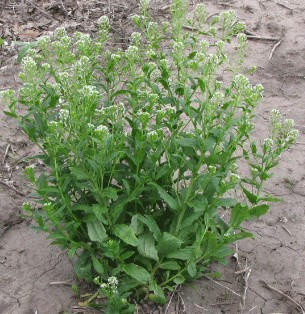
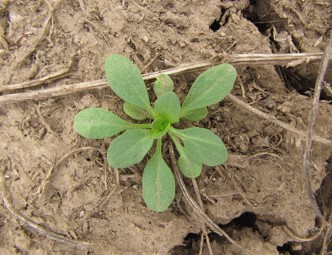
Figure 4. Field pennycress (top photo); rosette stage (lower photo).
Blue mustard
Blue mustard (Chorispora tenella) is a winter annual that germinates in the late summer and fall, and produces a rosette similar in appearance to a dandelion. The plant overwinters as the rosette. Blue mustard bolts in the spring. With mild February weather, the flower stalk may elongate in early March. Cold weather in February results in late March elongation. It bears purple or blue flowers at the top of the plant, which may grow from 12 to 18" tall. Seeds are produced in long, narrow seed pods 1 to 2 inches long. Viable seed can be produced approximately 10 days after bloom. Blue mustard is a problem in winter annual crops, such as winter wheat, throughout Kansas. Blue mustard was introduced into the U.S. from Siberia. Uncontrolled blue mustard can be extremely competitive with wheat, causing as much as 85% yield loss from season-long competition. Research at K-State in 2014 found more than 65% yield loss where blue mustard was not controlled until spring.
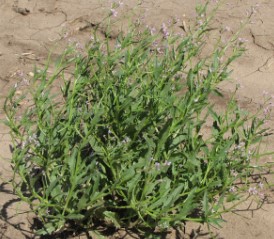
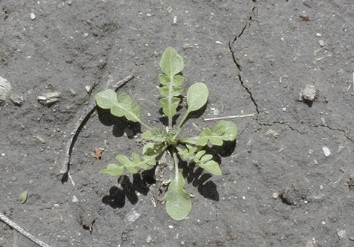
Figure 5. Blue mustard (top photo); rosette stage (bottom photo).
For detailed information on controlling the different mustard weeds in Kansas wheat fields, see the companion article in this eUpdate issue, “Control of mustards in wheat”.