By Shawn Arita and Rwit Chakravorty et.al
Following the start of “Operation Epic Fury” on February 28, 2026, risks to shipping through the Strait of Hormuz increased sharply. By early March, the Strait’s effective closure was already disrupting global oil and fertilizer supply chains and contributing to broader market uncertainty. This article examines the commodity market response in the first two weeks of the disruption and evaluates the vulnerability of the U.S. fertilizer supply to a prolonged closure.
Initial Commodity Market Response
Figure 1 highlights a clear divergence in commodity market responses to the Hormuz disruption, with energy markets experiencing the largest price increases and agricultural futures rising more modestly (see farmdoc daily article from March 17, 2026). Oil and gas futures increased sharply relative to pre-attack levels, as heating oil, crude oil, gasoline, and Brent crude rose by 5.8% to 50.4%. This strong response underscores the Strait of Hormuz’s importance as a global energy chokepoint and reflects market concerns over potential supply disruptions. Crop futures also increased, though by a smaller margin, with gains ranging from 3.6% to 8%. Soybean futures rose during the first two weeks but are down 0.1% from before the war started. Overall, the figure suggests that the disruption generated broad effects across commodity markets, but the most immediate and pronounced impacts were concentrated in energy markets.
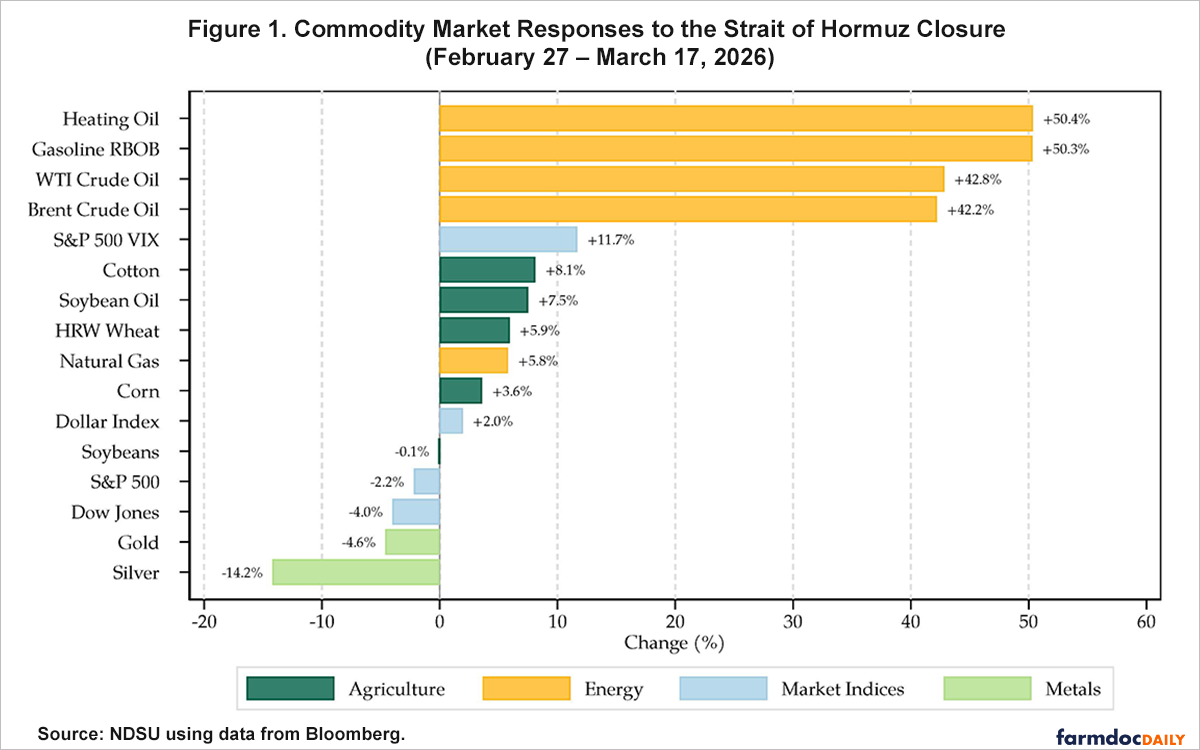
Broad market indices also pointed to heightened investor anxiety following the Hormuz disruption. Between the pre-attack date and March 17, 2026, the S&P 500, the leading benchmark for large-cap U.S. equities, fell 2.2%, while the Dow, which tracks 30 major publicly traded U.S. companies, declined 4.0%. At the same time, the VIX, a widely used measure of expected volatility in the S&P 500, rose by 11.7%. Together, these movements suggest that the disruption affected not only commodity markets but also broader financial sentiment.
Source : illinois.edu