The University of Georgia’s newest pecan variety will be released next spring and has shown good resistance against scab disease so far, according to Patrick Conner, a horticultural scientist at the UGA Tifton Campus.
“We always say ‘so far’ because the scab pathogen does tend to adapt to trees over time,” Conner said. “Currently, this variety has no scab in our sprayed orchards, and only trace scab in our unsprayed orchards.”
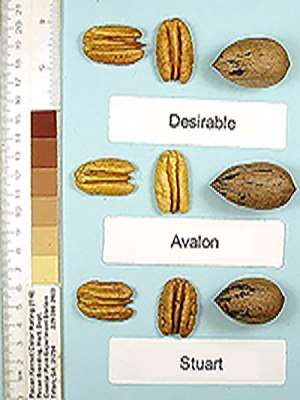
The Avalon variety has been patented by UGA, and four nurseries in Georgia are currently licensed to sell Avalon trees. Conner said the variety is unique because of its size and quality combined with high scab resistance.
“That combination of big size, high quality and high levels of scab resistance is fairly unique,” Conner said. “Most highly resistant cultivars are either small in size, or they don’t have the commercial quality we like to see.”
The Avalon variety’s biggest benefit is the decreasing number of times growers will have to spray fungicides, which will save a lot of money. Conner said that growers of the Desirable variety, Georgia’s most widely grown variety, were spraying 12 to 20 times a season, depending on rainfall.
“This variety would need only a couple of sprays per year,” Conner said. “It’s more profitable because you’re avoiding the expense of the fungicides.”
Conner said the new variety will also help growers fight scab during a very wet growing season.
“Even with full spray coverage on Desirable trees, in a really wet year, you could still get severe damage and crop loss,” Conner said. “Avalon gives you some assurance during a really wet year.”
Avalon was developed by crossbreeding two scab-resistant varieties. Separately, the varieties lacked sufficient quality, but together they produced seedlings that performed much better. More than 100 seeds were planted from the cross.
“We evaluated the trees in the field without spray,” Conner said. “The Avalon tree was the only one that had the combination of good nut quality and high levels of resistance. It’s really just a matter of making a cross, and then looking at enough seedlings to find all the traits you’re looking for.”
Conner said that the Avalon variety should be adaptable to any part of the state. It will be most important to south Georgia growers because of the higher scab pressure in the southern part of the state that makes growing traditional varieties, like Desirable, very difficult.
Pecans are a valuable Georgia commodity, worth more than $361 million in farm gate value in 2015, according to the Georgia Farm Gate Value Report, published by the UGA Center for Agribusiness and Economic Development.
“I’m hopeful that Avalon will allow growers to plant something besides Desirable that would need far fewer spray applications,” Conner said.
Source: uga.ed