By John Sawyer
Farmers are reminded to wait until soil temperatures remain below 50 degrees Fahrenheit before applying anhydrous ammonia (NH3) fertilizer this fall. Soil temperatures have been slow to cool due to the unusually warm late October temperatures, and officials with the Iowa Department of Agriculture and Land Stewardship and Iowa State University Extension and Outreach said that waiting can help reduce nitrogen loss and better protects the environment.
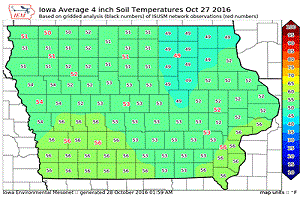
“It is important that farmers wait for cooler soil temps to apply anhydrous so that there is a better chance the fertilizer stays put and will be available to the crop next spring,” said Bill Northey, Iowa Secretary of Agriculture. “Soil temperatures, like air temperatures, can change quickly so it is important that we wait with applications until soils are likely to remain below 50 degrees.”
ISU Extension and Outreach maintains a statewide real-time soil temperature data map on its website that agriculture retailers and farmers use to determine when fall N applications are appropriate. The website can be found at extension.agron.iastate.edu/NPKnowledge.
“The reason for waiting to apply anhydrous ammonia until soils are cold is that nitrification, the process of biological conversion of ammonium to nitrate, occurs at a more rapid rate with warm soils. Since ammonium-N does not leach and is not subject to denitrification, as is nitrate, it is more stable in the soil,” said John Sawyer, professor and extension specialist in soil fertility and nutrient management at Iowa State University.
In addition to waiting for soils to cool below 50 degrees, use of a nitrification inhibitor should be considered to help further slow conversion to nitrate.
Temperature is only one soil condition that farmers should consider when applying anhydrous ammonia. Making sure that the soil is not too dry, too hard or too wet, will reduce injection issues that allow ammonia to move to the soil surface and be lost to the air. If conditions are not suitable, then waiting for better conditions is suggested.
Farmers with questions about timing of fertilizer applications can talk to their local ISU Extension and Outreach field specialist or their ag retailer for more information.
Source: iastate.edu