By James Mitchell
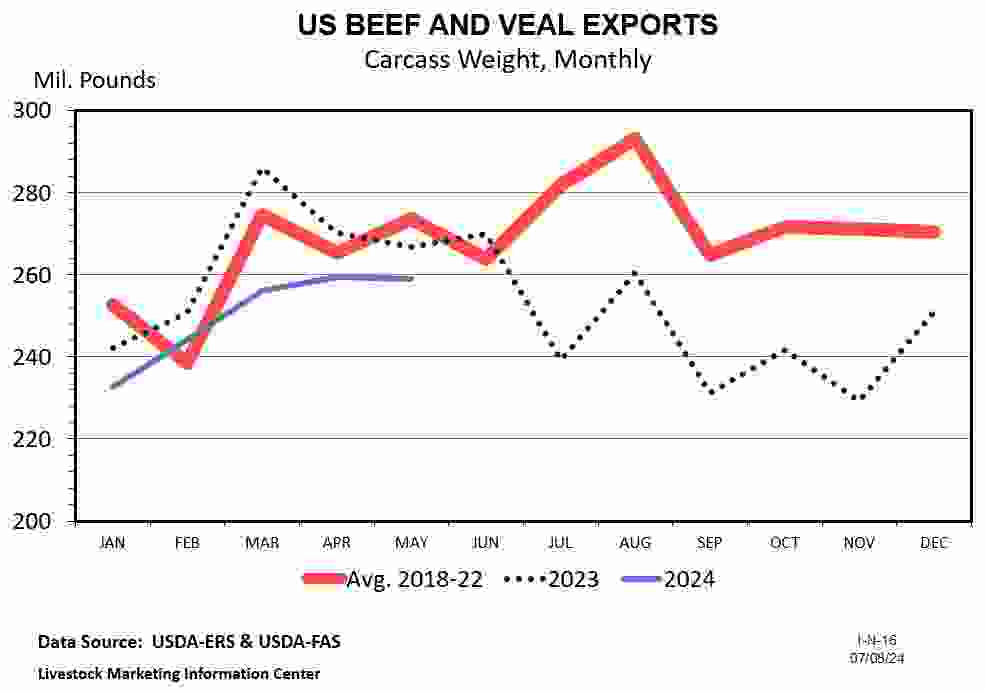
USDA ERS published the latest beef trade data the first week of July, showing a decline in beef exports compared to a year ago. Specifically, U.S. beef exports declined 2.9 percent in May compared to a year ago. Beef imports were 10.4 percent higher in May 2024 compared to last year. Total beef exports for January through May are 4.9 percent below 2023 levels, and Jan-May beef imports are 19.5 percent above last year.
The top five destinations for U.S. beef account for 76 percent of total beef of May 2024 beef exports. These countries include Japan, South Korea, China, Mexico, and Canada. Japan, the leading country for U.S. beef, accounts for 21 percent of total exports in May 2024. Five countries account for 83 percent of U.S. beef imports in May 2024. These countries include Canada, Australia, New Zealand, Mexico, and Brazil. Imports from Canada in May are 22 percent of the May beef import total.
USDA in the June WASDE forecasts 2024 beef exports at 2.818 billion pounds, or 7.2 percent lower than 2023 exports. The USDA forecast for 2025 beef exports is 2.500 billion pounds, or 11.3 percent lower than the current 2024 forecast. Several factors contribute to lower beef exports in 2024 and 2025. These factors include economic conditions in the U.S. and other countries, exchange rates, and the relative value of U.S. beef compared to our competitors. Perhaps it is more obvious that exporting more of something is difficult when less is produced.
Weekly U.S. beef production is averaging 1.5 percent below last year. USDA forecasts 2024 beef production at 26.657 billion pounds or 1.4 percent lower year over year. USDA forecasts a 4.6 percent decline in 2025 beef production. Most of the decline in current beef production comes from declines in cow slaughter. However, as smaller calf crops and fewer heifers when herd expansion does begin, fed cattle slaughter will decline significantly. So, domestic beef production will become one of the main factors contributing to lower expected beef exports when herd expansion begins.
USDA forecasts 2024 beef imports at 4.171 billion pounds or 11.9 percent higher than 2023 beef imports. The USDA forecast for 2025 beef imports is 4.225 billion pounds and is 1.3 percent higher than the current 2024 forecast. The domestic ground beef market is the main driver of U.S. beef imports and is highly correlated with the rate of domestic cow slaughter which is the other source of lean trim for ground beef.
Source : osu.edu