By Heidi Wollaeger
.
In “Michigan’s floriculture and greenhouse industry – Part 1,” I summarized a 2015 survey performed by the National Agricultural Statistics Service (NASS) of Michigan greenhouse and nursery growers, including the number of operations in Michigan, the fuel type used for heating and its costs, and uses of supplemental lighting in the industry. With the input of the Michigan Floriculture Growers Council, additional questions on business challenges were also included in this survey.
According to the survey, the greatest proportion (32 percent) of floriculture growers in Michigan sold to re-wholesalers (brokers) followed by mass merchandizers (27 percent). Only 9 percent of Michigan ornamental plants were sold directly to landscapers or small garden center chains. The top five destination states for Michigan’s plant material were Michigan, Illinois, Indiana, Ohio and Wisconsin.
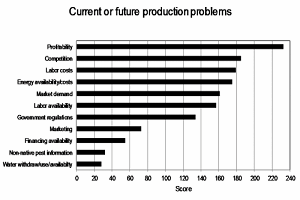
According to the survey, the top four business challenges facing the floriculture industry in Michigan were profitability, competition, labor costs and energy availability/costs (Figure 1). The rising production costs and relatively stagnant sales prices contributed to the decreasing margins on plant products. According to the survey, the least important challenges, as identified by the floriculture industry, were non-native pest information and water availability.
Fifty-four percent of floriculture businesses were established prior to 1990, while 25 percent of these businesses were established since 2001. Eighty percent of the owners or operators of floriculture businesses were older than 51 years in age and 17 percent were older than 71 years old. Unfortunately, only an average of 33 percent of businesses reported having a business succession plan. Larger businesses with greater sales were more likely to have business succession plans. Fifty-two percent of owners with sales over $500,000 had a succession plan. Of businesses with greater than a half of a million dollars in sales, 20 percent of these businesses planned to expand within the next year.
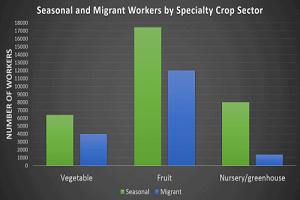
The third greatest concern of floriculture businesses was labor cost. The nursery and greenhouse industry employed over 13,000 workers in Michigan. Just under half of those employees were either part-time or full-time seasonal workers. In comparison to other agricultural industries in Michigan, greenhouses and nurseries hired more seasonal labor than vegetable growers, but less than half of that of the Michigan fruit industry (Figure 2). The nursery and greenhouse industries employed far fewer migrant employees compared with either vegetable or fruit growers. The mean wage per hour for seasonal workers did increase from approximately $9.50 to $10 from 2013 to 2014.
Source: msu.edu