Farms.com Home   News

Potatoes, Tomatoes, And Sweet Corn Remain Most Popular Vegetables Among U.S. Consumers

 
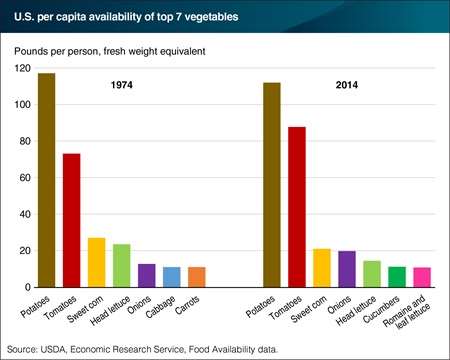
According to ERS’s food availability data, an average of 385.4 pounds of fresh and processed vegetables per person were available for U.S. consumers to eat in 2014, up from 334.1 pounds in 1974, but down from peak per capita vegetable availability of 424.3 pounds in 1996. Potatoes, tomatoes, and sweet corn were the three most popular vegetables in 1974 and remained the most popular in 2014. While per capita availability (a proxy for consumption) of potatoes and sweet corn has declined over the last four decades, per capita tomato availability grew from 73.2 pounds in 1974 to 87.8 pounds in 2014. Fresh tomato availability increased by 74 percent and canned tomatoes by 10 percent. Onion availability also grew from 12.7 to 19.7 pounds per person over 1974-2014. In 2014, cucumbers and romaine and leaf lettuce at 11.3 and 10.8 pounds per capita, respectively, replaced cabbage and carrots in the top 7 rankings. Head lettuce was the fourth most popular vegetable in 1974, but dropped to fifth in 2014, perhaps related to the growing popularity of romaine and leaf lettuce. The data for this chart come from the Food Availability data series, part of ERS’s Food Availability (Per Capita) Data System, updated August 3, 2016. 
 

Trending Video

Why Invest in Canada’s Seed Future? | On The Brink: Episode 3

Video: Why Invest in Canada’s Seed Future? | On The Brink: Episode 3

Darcy Unger just invested millions to build a brand-new seed plant on his farm in Stonewall, Manitoba so when it’s time for his sons to take over, they have the tools they need to succeed.

Right now, 95% of the genetics they’ll be growing come from Canadian plant breeders.

That number matters.

When fusarium hit Western Canada in the late 90s, it was Canadian breeders who responded, because they understood Canadian conditions. That ability to react quickly to what’s happening on Canadian farms is exactly what’s at risk when breeding programs lose funding.

For farmers like Darcy, who have made generational investments based on the assumption that better genetics will keep coming, the stakes are direct and personal.

We’re on the brink of decisions that will shape our agricultural future for not only our generation, but also the ones to come.

What direction will we choose?

On The Brink is a year-long video series traveling across Canada to meet the researchers, breeders, farmers, seed companies, and policymakers shaping the future of Canadian plant breeding. Each week, a new story. Each story, a piece of the bigger picture.

Episode 3 is above. Follow Seed World Canada to catch every episode, and tell us: Do you think the next generation will have the tools they need to success when they takeover? How is the future going to look?