By Dr. Katie VanValin
Developing and first calf heifers are not the same as mature cows. While that seems like an obvious statement, there is still a common belief that heifers should be able to “get by” under the same management as mature cows. The thought is that we are selecting heifers that match available resources when we should be selecting heifers that will become cows that match our resources. Because heifers still have additional nutrient requirements for growth, they require different nutritional management than cows.
In the beef industry we talk about selecting “heifer-acceptable” bulls all the time, because we understand the need for emphasis on calving ease in heifers compared to mature cows. If we are going to keep back our own replacements or develop heifers, we also need to think about selecting a heifer acceptable feeding program.
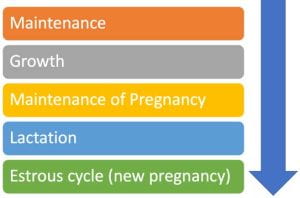
Decades of research have helped us understand how heifers and cows prioritize nutrients (figure 1). The first priority is meeting maintenance requirements these are the nutrients needed to keep the animal alive and maintaining their current body condition. Next up is supporting lactation, followed by growth (for growing females), supporting an existing pregnancy, and lastly the estrous cycle or the ability to breed back.
First-calf heifers are particularly vulnerable in a cow-calf operation. They must do everything a mature cow does raise a calf and breed back while also continuing to grow. The consequence of not meeting her nutrient requirements is the inability to breed back, often resulting in young females being culled from the herd. Developing heifers is a significant investment, with costs spread over the animal’s productive lifetime. Research has shown that it takes at least 4-5 years for a heifer to pay for herself. When first-calf heifers fail to breed back and are culled, it almost always results in a net loss to the operation. Not only have we failed to recoup her development costs, but we’ve also lost out on potential income from her future calves.
Reproductive failure in these young females is often wrongly blamed on genetics, but we know reproductive traits are lowly heritable. The real blame is likely due to nutrition, or more specifically undernutrition. The good news is that nutrition is something we can manage and control. Young growing females are smaller than their mature cow counterparts which means that their feed intake will be less than that of the mature cow. With less feed intake, this means that heifers require diets with greater concentrations of energy and protein.
In a typical spring calving system, the herd will likely be consuming lush forages during the breeding season but looking at the critical time leading up to breeding season, most herds will be consuming conserved forages. When thinking about supplementing average quality cools season grass hay, a lactating cow may require 3 lbs. of dried distillers grains, whereas a heifer consuming this same hay would require 5 lbs. of dried distillers grains.
To ensure that heifers are meeting their nutrient requirements, consider managing these young females in a separate group from the rest of the cow herd. For smaller herds, it may also make sense to manage any mature cows that have a low body condition score with these young females. This can allow for strategic supplementation for cattle needing extra nutrition without overfeeding mature cows that are in good body condition.
Always test your hay, and consider feeding higher quality forages to heifers, which can reduce supplemental feed costs. Another benefit to hay testing is the ability to select supplemental feeds that provide the best value based on the amount of supplemental energy or protein required by the herd. Energy is often the most limiting ingredient in forage-based systems, and it is highly unlikely that average quality grass hay is going to be an adequate source of energy for developing heifers, lactating first-calf heifers, or even lactating mature cows. Careful consideration should be made to provide adequate energy as well as protein in the diet.
At the end of the day, it is important to remember that developing and first-calf heifers are simply not the same as the mature cows in the herd. Take care to manage these animals to set them up for long-term success and longevity in the herd.
Source : osu.edu