By Chabella Guzman and Gary Stone
Temperatures will remain warm for this time of year, and harvest continues for dry beans and sugar beets.
“Early-planted dry beans will need a good three to four weeks of good weather to finish out,” said Gary Stone, Nebraska Extension educator.
Corn silage is another crop being harvested in western Nebraska. The silage is the result of chopping the whole corn plant and packing it in a way that will ferment.
“As a result of this anaerobic fermentation, sugars present in the plants become acetic and lactic acids, allowing the long-term preservation of the material for livestock feed,” said Pablo Loza, Nebraska Extension beef feedlot specialist.
The corn is still green, but it has stopped supplying nutrients to the grain on the cob, typically known as the black layer. The properly processed silage is fed to the Panhandle Research Feedlot cattle and is a key component of their rations throughout the winter months.
Irrigation water deliveries will cease for most surface water irrigation districts in the North Platte Valley on or around Monday, Sept. 16. Pathfinder irrigation district is diverting approximately 1,700 cfs, and Goshen/Gering-Fort Laramie irrigation district is diverting approximately 1,375 cfs.
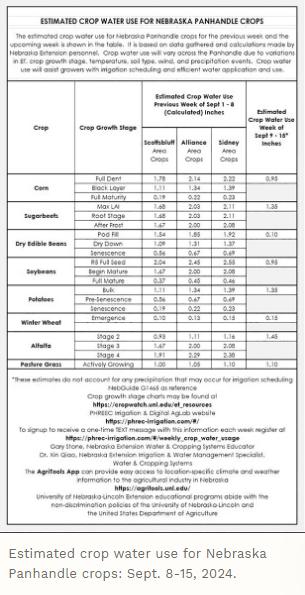
Assisting growers with monitoring their crop's water profile is the estimated crop water use for Sept. 8-15. The table information includes the estimated crop water use for Nebraska Panhandle crops for the previous week and the upcoming week. The table is based on data gathered and calculations made by Gary Stone, Nebraska Extension educator, and Dr. Xin Qiao, extension irrigation and water management specialist, both based at the UNL Panhandle Research and Extension Center in Scottsbluff, Nebraska.
Crop water use will vary across the Panhandle due to variations in ET, crop growth stage, temperature, soil type, wind and precipitation events. Crop water use will assist growers with irrigation scheduling and efficient water application and use.
Source : unl.edu